72% of telecom operators believe their AI is trustworthy. Only 14% can produce evidence to prove it, according to research TM Forum conducted with IBM's Institute for Business Value.
That gap is now the industry's stated bottleneck to running AI on live networks, not model capability. Confidence without evidence isn't a foundation anyone wants underneath infrastructure that can't go down.
This guide covers agentic AI in telecom specifically: how network operations and telecom-specific customer care actually work, building on the resolution patterns already outlined in Tecla's Agentic AI Contact Center guide.
What Is Agentic AI in Telecom?
Agentic AI in telecom is a system that monitors network conditions, diagnoses faults, and proposes or executes a fix within approved limits, rather than following a fixed automation script written for a specific, anticipated failure.
TM Forum, the industry's standards body, measures that shift using its Autonomous Network Levels: a maturity scale from Level 0, fully manual, to Level 5, fully autonomous. Most operators today are still working toward Level 4.
In network operations, that difference shows up in how a fault gets handled. A scripted rule matches a known error pattern to a known fix.
An agentic system reasons about a fault it hasn't seen exactly this way before, using the same mental model an experienced engineer would.
From Scripted Automation to the Control-Gate Model
TM Forum's own analysis describes three architectures operators are testing. The first pairs a language model with company documents, useful for looking things up but unable to actually change the network.
The second connects a model to existing network tools, which speeds up manual workflows but still leans on the original tooling to execute anything.
The third pairs a general-purpose model for conversation with a domain-specific model trained on the operator's own infrastructure, which works out the next best action for the network itself.
TM Forum's research treats this third approach as the one capable of reaching the highest autonomy levels.
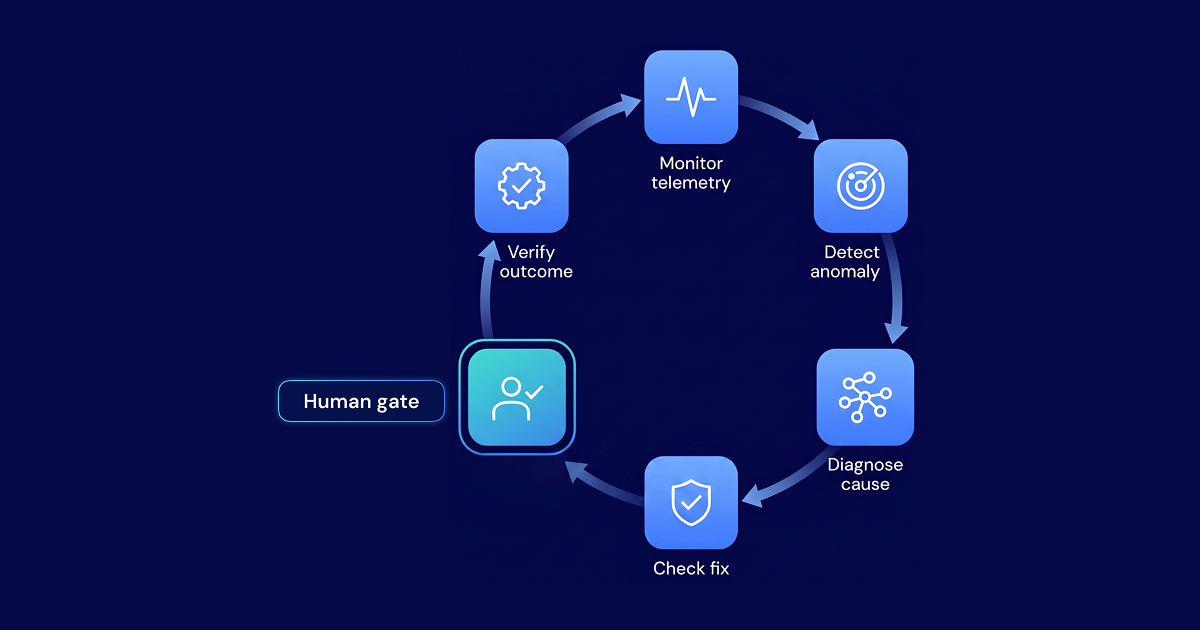
Every architecture converges on the same governance idea: before an action executes, it passes through control gates checking security impact, service-level risk, how far a failure could spread, and whether it can be rolled back.
The Network Operations Workflow, Step by Step
The workflow below covers fault detection and response specifically, one of the clearest agentic AI use cases in telecom operations today.
The sections after it cover network planning, telecom-specific customer care, and the trust gap driving how carefully agentic AI telecom deployments get rolled out.
Network Planning and Capacity Optimization
Deciding where to add capacity or adjust configuration ahead of demand used to mean waiting for a quarterly planning cycle to catch up with what the network was already showing in real time.
An agent correlating usage trends, device growth, and event calendars can flag a capacity gap before it becomes congestion, rather than after customers start noticing dropped connections.
Customer Care: Billing, Activation, and Outage Reporting
Telecom customer care carries its own specific volume: bill shock disputes, device and SIM activation, and outage reports that need to route back to network operations rather than sit in a generic support queue.
An agent that reads a customer's actual usage and plan details can resolve a billing dispute directly, and one that correlates an outage report against a known network incident can close the loop between customer care and the operations team handling the fix.
The Trust Gap and Why Evidence Matters More Than Confidence
TM Forum's chief executive called trustworthiness the leading driver of telco brand value, ahead of coverage and price. That framing matters because it reorders the priority: proving an agent's reasoning matters more than how confident it sounds.
The control-gate model exists precisely to convert confidence into evidence, requiring a documented answer to specific questions, what could go wrong, how far it spreads, whether it's reversible, before anything executes.
The Network Engineer's Role
The engineer's job shifts from executing routine fixes by hand to supervising an agent's diagnosis and reasoning, the exact work TM Forum's framework calls expert-agent collaboration.
Engineers stop doing the hands-on repetitive work and start checking whether the agent's proposed fix actually holds up, retraining the model on what they find.
Implementation: Guardrails Specific to Telecom
Every guardrail below mirrors the control-gate discipline operators already apply to human-initiated network changes, extended to agentic ones.
The Team Behind Production Agentic AI
The gap between 72% confidence and 14% proof is exactly where most agentic telecom deployments actually fail. Building the evidence trail is harder and more valuable than building the diagnosis itself.
Tecla's Agentic AI services design, build, and operate this workflow directly, the same monitoring, diagnosis, and customer care systems above, running in your stack with the evals and guardrails production requires.
Or bring the expertise in-house: AI engineers who've worked on live telecom systems, past the demo stage.
Tecla runs a network of senior engineers across the US and Latin America, built over more than a decade, with a top 3% acceptance rate and first candidates in 3 to 5 business days.
FAQ


.png)
%20(1).avif)
.avif)
.avif)