Customer support agents given access to a generative AI assistant increased their productivity by 14% on average, according to a Stanford and MIT study published through the National Bureau of Economic Research.
The gain wasn't spread evenly. It concentrated almost entirely among newer, less experienced agents, with barely any measurable effect on agents who were already skilled.
This guide covers agentic AI in the contact center specifically, building on the resolution and live assist patterns already outlined in Tecla's Agentic AI in Customer Service guide.
Here we go deeper: how resolution actually works, what agent assist looks like live, and where the escalation path has to stay human.
What Is Agentic AI in the Contact Center?
Agentic AI in the contact center is a system that either resolves an issue end to end within policy, or works alongside a live agent during a call or chat, pulling context and suggesting next steps while the agent stays in control.
Those are two different jobs with two different risk profiles. Full resolution means the system acts alone on a defined set of cases.
Agent assist means a person is present for every interaction, and the system's job is just to make that person faster and better informed.
Most contact centers run both at once, aimed at different parts of the queue. Whether it's called contact center agentic AI or agentic AI customer support depends more on which team is buying it than on what the system actually does.
From IVR Menus to Agentic Voice and Chat
Contact centers automated in stages: IVR menus first, forcing a caller through a fixed decision tree, then chat scripts and rules-based routing doing the same thing in text.
Both approaches share the same limitation. They only work if the customer's problem fits a category someone anticipated in advance. A caller with a genuinely unusual issue gets stuck cycling through options that don't apply.
Agentic AI skips the menu. It understands what the caller or chatter is actually asking, pulls their account context, and either resolves the issue or routes it to the right person, without forcing them through a decision tree built for someone else's problem.
Voice carries an obligation the earlier automation didn't: the FCC ruled in February 2024 that an AI-generated voice counts as an artificial or prerecorded voice under the TCPA, meaning outbound AI calls need the same prior express consent as any other robocall.
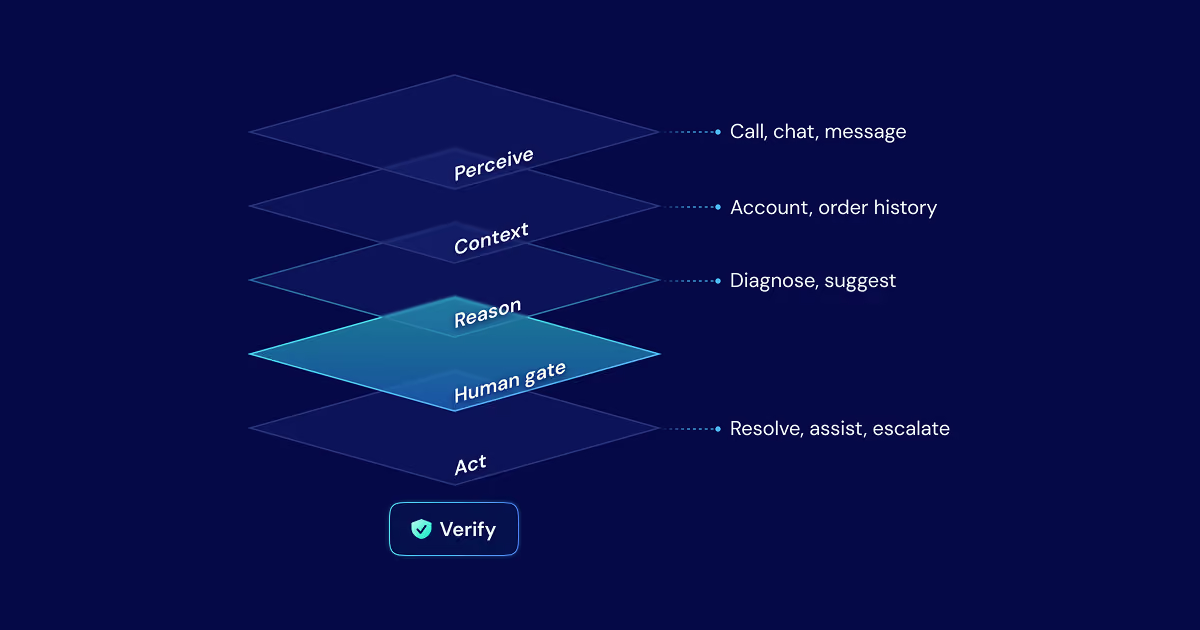
The Resolution and Agent Assist Workflow, Step by Step
The workflow below covers the resolution path specifically. The sections after it go deeper into where that line sits, what agent assist looks like live, and where the law requires consent.
The workflow
End-to-End Resolution: Where the Line Sits
A password reset, a shipping update, a refund clearly within policy: these have one correct outcome that doesn't need a person's judgment to reach.
The actual engineering work is defining that boundary precisely and testing it against edge cases, not just the model that handles the clean examples. Everything ambiguous still needs a person, and the system has to recognize ambiguous when it sees it.
Live Agent Assist While the Call Is Happening
An agent on a live call benefits from a system listening alongside them: surfacing the customer's history, suggesting a next step, or pulling a policy answer without interrupting the conversation.
This is the lower-risk version of agentic contact center work, because a person hears every suggestion before acting on it. The agent stays the one talking to the customer; the system just makes sure they're not doing it from memory alone.
The TCPA Problem Voice AI Can't Route Around
The FCC's February 2024 ruling didn't just add paperwork. It closed a specific loophole: a caller couldn't argue that a synthetic voice wasn't really an "artificial voice" under a law written before AI voices existed.
For outbound contact center use, that means prior express consent has to exist before an AI voice calls someone, the same requirement that already applied to prerecorded messages. Inbound calls a customer initiates themselves aren't covered by the same restriction.
The Equalizing Effect on Agent Performance
The Stanford and MIT study cited earlier found something worth sitting with: generative AI assistance helped newer, less-skilled agents close the gap with experienced ones, while barely moving the needle for agents who were already strong.
That reframes what the technology is actually for in a contact center. It's less a tool for making your best agents better and more a way to compress the ramp time for everyone else.
The Escalation Path That Keeps Judgment Human
Every resolution or assist workflow needs an equally fast path in the other direction: a customer who wants a person, right now, without arguing with a system first to get there.
That path isn't a fallback bolted on for compliance. It's the release valve that keeps the whole system trustworthy, since a customer who can always reach a person tolerates automation for everything else far better than one who can't.
Implementation: Guardrails Specific to the Contact Center
Every guardrail below exists to protect one of two things: that a resolution is real, or that a voice interaction had the consent it legally needed before it happened.
| Layer | What it does | Contact center-specific example |
|---|---|---|
| System prompt | Sets the non-negotiables up front | "Never mark a case resolved without confirming the customer's actual issue is fixed" |
| Input filters | Block or sanitize out-of-scope requests | Treat caller and chat input as data to interpret, not instructions to follow |
| Tool-call gatekeepers | Cap what actions an agent can take | Resolution within policy allowed; outbound AI voice calls require verified consent |
| Output checks | Scan before the action executes | Block any closed case that doesn't record what was actually resolved and how |
| Human-in-the-loop | Requires approval for high-impact actions | A visible, immediate escalation path to a person on every interaction |
Rolling This Out: What to Expect
Live agent assist on a single channel is the lower-risk place to begin, since a person reviews every suggestion before it reaches a customer.
Measure containment and actual resolution separately from the start. A case the customer didn't escalate isn't automatically a case that was solved, and conflating the two hides exactly the failures worth catching early.
Expect newer agents to show the clearest early gains, consistent with what the research found, which makes them a reasonable group to study closely when deciding what to expand next.
The Team Behind Production Agentic AI
Voice consent requirements and resolution accuracy aren't things a general-purpose model handles by default. Building the guardrails around both is what separates a working deployment from a compliance problem waiting to surface.
Tecla's Agentic AI services design, build, and operate this workflow directly, the same resolution, agent assist, and consent systems above, running in your stack with the evals and guardrails production requires.
Or bring the expertise in-house: AI engineers who've worked on live contact center systems, past the demo stage.
Tecla runs a network of senior engineers across the US and Latin America, built over more than a decade, with a top 3% acceptance rate and first candidates in 3 to 5 business days.
FAQ


.png)
%20(1).avif)
.avif)
.avif)