.avif)
Meta's own automated ad product, Advantage+, only outperformed manually managed campaigns in 42% of cases, according to a study of 640 incrementality tests by the measurement firm Haus, reported by AdExchanger.
When it did win, the efficiency gains weren't dramatic.
That's not an argument against automation. It's a reminder that platform-native automation optimizes for what a platform can see, and what a platform can see isn't the same thing as what a business actually gained.
This guide covers agentic AI in digital marketing specifically, building on the campaign monitoring pattern already outlined in Tecla's Agentic AI in Marketing and Sales guide.
Here we go deeper: how monitoring and budget reallocation actually work, and where blind trust in the algorithm goes wrong.
What Is Agentic AI in Digital Marketing?
Agentic AI in digital marketing is a system that monitors performance across campaigns and channels, and reallocates budget toward what's working, within limits a marketer sets in advance.
How can agentic AI be used in marketing beyond that core loop? Mostly by extending the same pattern: watching a signal continuously, comparing it against a baseline, and acting only within limits someone set in advance.
That's a different job than what a single platform's own automation does. Google's Performance Max and Meta's Advantage+ both optimize aggressively inside their own campaigns, adjusting bids, creative, and targeting in real time.
Neither one moves budget between Google and Meta, or notices that a seasonal shift means a different channel should get more spend next week.
An agentic layer sits above that: watching performance across every channel at once, and reallocating budget across the boundaries no single platform's automation can see past.
Why Platform-Native Automation Isn't the Whole Answer
Performance Max and Advantage+ both promise the same thing: hand over targeting and budget decisions, and the algorithm finds the customers worth reaching.
The Haus study put a number on how reliably that promise holds. Advantage+ delivered 12% lower incremental return on ad spend at 18% lower daily spend when it did beat manual campaigns, and drove 17% less lift during the post-campaign observation window.
The likely explanation is that the algorithm gets very good at finding people who were already about to buy, which looks like performance on a dashboard but isn't necessarily new revenue.
Agentic budget reallocation doesn't replace platform-native automation. It adds a layer that checks platform-reported performance against actual incremental results, and moves budget based on the latter.
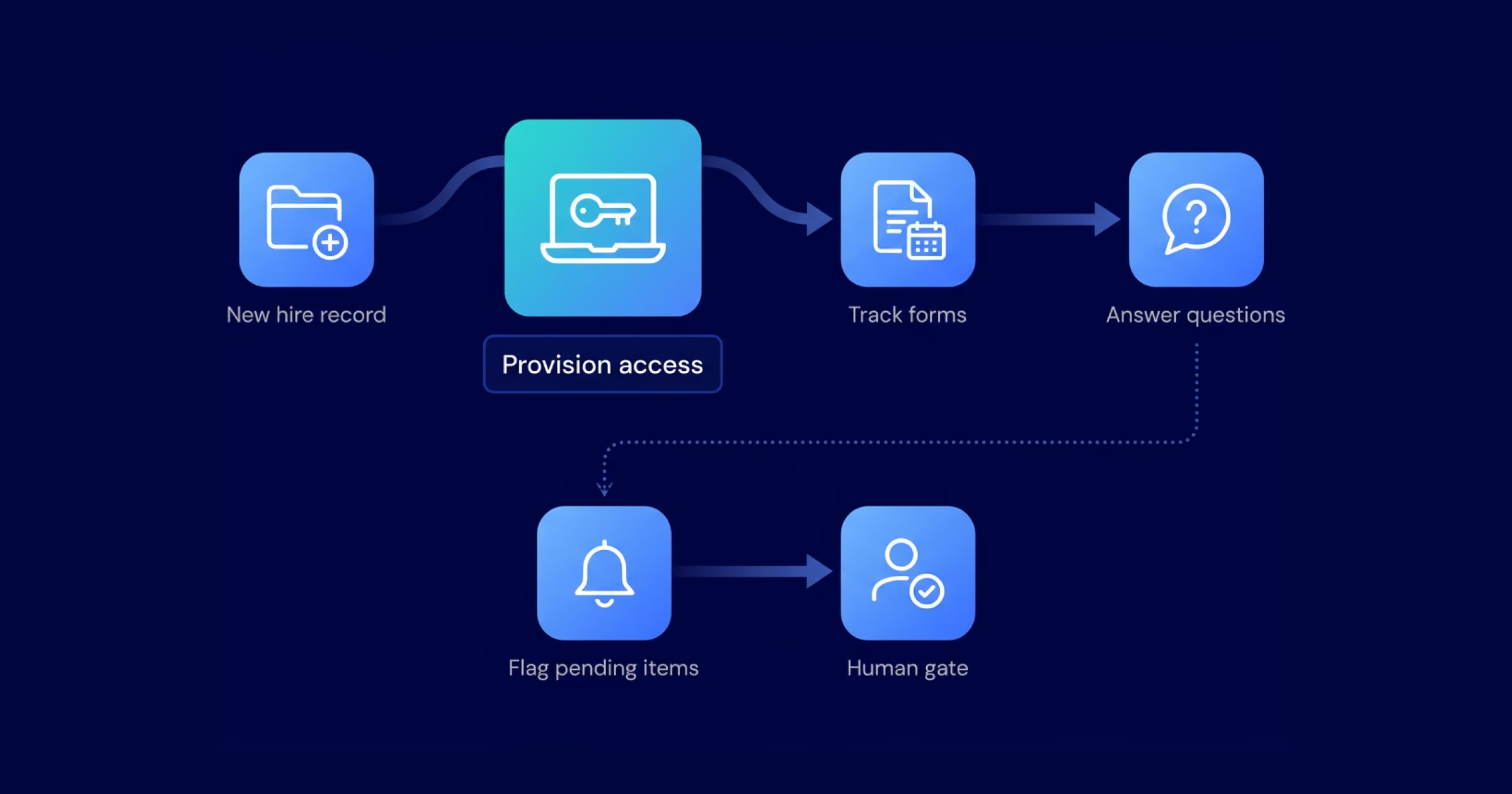
The Monitoring and Reallocation Workflow, Step by Step
The workflow below covers cross-channel monitoring specifically. The sections after it cover why platform-reported performance can mislead, and what a marketer's role looks like once the agent is running.
The workflow
Platform-Reported Performance Versus Actual Lift
A platform's own dashboard measures what it can attribute, and attribution rewards whichever channel touched a customer last, not necessarily the channel that actually created the sale.
Incrementality testing, turning campaigns off for a holdout group and comparing actual outcomes, answers a different, more useful question: would this sale have happened anyway.
An agent reallocating budget without that check is optimizing for a number that can look great and still not reflect real growth.
Budget Reallocation Within Guardrails
Letting an agent move money between channels without limits is how a genuinely bad week turns into a genuinely bad month. The guardrails matter as much as the reallocation logic itself.
A reallocation limit, a maximum percentage shift per day, a floor below which a channel can't drop, keeps the agent's authority matched to how much confidence the underlying data actually deserves.
The Marketer's Role
The marketer's job shifts from manually checking dashboards across five platforms to reviewing what the agent already flagged, and deciding whether a reallocation outside the guardrails makes sense.
Creative strategy, brand positioning, and the incrementality testing design itself stay with a person. The agent's job is to notice the drift fast enough for that person to act on it.
Implementation: Guardrails Specific to Digital Marketing
A slow campaign gets noticed within a day. A confidently wrong reallocation can run for weeks before anyone checks whether the channel it favored actually earned that budget.
| Layer | What it does | Digital marketing-specific example |
|---|---|---|
| System prompt | Sets the non-negotiables up front | "Never shift more than the pre-set percentage of budget in a single day" |
| Input filters | Block or sanitize out-of-scope requests | Treat platform-reported conversions as one signal, not the only signal |
| Tool-call gatekeepers | Cap what actions an agent can take | Monitoring and small reallocations allowed; large shifts always need a human |
| Output checks | Scan before the action executes | Block any reallocation that hasn't been checked against incrementality data |
| Human-in-the-loop | Requires approval for high-impact actions | A marketer approves any reallocation that exceeds the pre-set threshold |
Rolling This Out: What to Expect
Monitoring and alerting alone, with no reallocation authority at all, is the safest place to begin. Let the agent flag drift and see how often those flags turn out to be right before it ever touches a budget.
Run an incrementality test alongside the agent's early recommendations to check whether what it flags as underperformance actually corresponds to a real drop in incremental results.
Widen the agent's authority gradually as its recommendations hold up against incrementality data, not just against platform-reported metrics that were never designed to answer that question.
The Team Behind Production Agentic AI
Anyone can wire an agent up to a platform's API. The differentiator is building the incrementality checks that keep it honest about what's actually working.
Tecla's Agentic AI services design, build, and operate this workflow directly, the same monitoring, reallocation, and validation systems above, running in your stack with the evals and guardrails production requires.
Or bring the expertise in-house: AI engineers who've worked on live marketing systems, past the demo stage.
Tecla runs a network of senior engineers across the US and Latin America, built over more than a decade, with a top 3% acceptance rate and first candidates in 3 to 5 business days.
FAQ


.png)
%20(1).avif)
.avif)