
Hire MLOps Developers
Hire nearshore MLOps developers from Latin America in 5 days, at a fraction of US costs. Build your dream team while saving up to 60%, without compromising on quality or timezone compatibility.






.avif)
MLOps Developers Ready to Scale Your Models


.svg)
.svg)
Experienced building ML infrastructure and deployment pipelines. Has worked with multiple MLOps tools and cloud platforms. Strong background in CI/CD for machine learning systems.

Builds and maintains ML training and serving infrastructure. Experience with model monitoring and versioning systems. Has worked at fintech and AI-focused companies.

DevOps engineer specializing in ML workflows and model deployment. Comfortable with infrastructure as code and automated testing. Has built end-to-end ML pipelines at scale.

Works on feature stores and model training pipelines. Experience with batch and real-time ML systems. Background in building data platforms for analytics and ML teams.

Focuses on model deployment and production monitoring. Has experience with model serving frameworks and A/B testing infrastructure. Works on ML system reliability and performance.

Maintains ML deployment pipelines and monitoring systems. Learning advanced MLOps practices and cloud infrastructure. Works on model versioning and automated retraining workflows.



Why Hire MLOps Developers Through Tecla?

5-Day Candidate Match
You get qualified MLOps developers in 5 days on average. Traditional recruiting takes 6+ weeks just to find someone who claims Kubernetes and ML experience.

Elite 3% Pass Rate
Three out of every hundred applicants clear our vetting. You interview engineers who've already proven they can deploy models to production, not just run notebooks.

40-60% Lower Costs
Senior talent at less than half US market rates. Same CI/CD expertise, same infrastructure knowledge, different geography.

97% Retention Rate
Almost every placement stays past year one. We match on deployment philosophy and team culture, not just tool lists on resumes.

Your Hours, Their Hours
Developers working within 0-3 hours of US timezones. Model deployments happen during your workday, production issues get fixed before you leave the office.
.avif)
What Our Clients Say

"Tecla successfully found candidates for our team and handled the entire process from scheduling to interviews. They were timely, responsive, and always kept communication flowing through email and messaging apps. I was really impressed with Tecla’s follow-up and thoroughness throughout the process."
"I’m very happy with Tecla. Their support has improved our QA process, reduced bug reports by half, and made our onboarding process twice as fast. The team is responsive, cost-effective, and delivers high-quality candidates on time. Tecla has truly become a trusted extension of our internal hiring team."
"Tecla is organized and provides a strong partnership experience. From hiring multiple engineers within weeks to maintaining consistent communication and feedback, they’ve shown real professionalism. Their follow-up and collaboration made the entire staffing process efficient and enjoyable."
What Our MLOps Engineers Deliver

Data Warehouse Design & Modeling
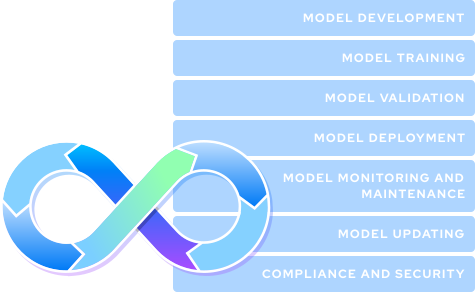
Production ML pipelines handling training, evaluation, and deployment at scale. Our developers work with Kubernetes, Docker, MLflow, and cloud platforms to build automated workflows that move models from notebooks to production reliably.

Model Deployment & Serving Infrastructure
End-to-end model serving architecture with proper versioning, A/B testing, and rollback capabilities. Expertise in TorchServe, TensorFlow Serving, KServe, and REST API design for models serving millions of predictions daily.

Monitoring & Observability Systems
Comprehensive monitoring for model performance, data drift, infrastructure health, and prediction latency. They build alerting systems that catch model degradation before customers notice and dashboards that make ML systems transparent.

CI/CD for Machine Learning
Automated testing pipelines for ML code, model validation frameworks, and deployment automation. Documentation and runbook creation so your data scientists can deploy models independently without constant DevOps support.
Hire MLOps Developers in 4 Simple Steps

Tell Us What You Need
Share the specific skills, experience level, and tech stack you're looking for. We'll schedule a brief call to understand your requirements and timeline.

Review Pre-Vetted Candidates
Within 3-5 days, receive a curated list of MLOps developers who match your criteria. Every candidate has already passed our technical assessments and cultural fit evaluations.

Interview Your Top Choices
Schedule interviews with the candidates you're most interested in. Assess their technical abilities, communication style, and how well they'd integrate with your team.

Hire and Onboard
Extend an offer to your preferred candidate and start working together. We'll handle the paperwork and logistics so you can focus on integrating your new hire into the team.
Our Hiring Models
We offer two approaches depending on whether you need individual contributors or a fully managed team.
Staff Augmentation
Nearshore Teams
True Cost to Hire MLOps Developers: LATAM vs. US
Location dramatically impacts your hiring budget. When you hire MLOps developers in the US, you're not just paying salary. Health insurance, retirement matching, payroll taxes, and recruiting fees push total costs far beyond posted compensation.
US Full-Time Hiring: Hidden Costs

- Health insurance: $10K-$15K
- Retirement contributions: $9K-$18K (401k matching)
- Payroll taxes: $13K-$17K (FICA, unemployment)
- PTO: $8.5K-$11K (accrued time off)
- Administrative costs: $5K-$8K (HR, payroll processing)
- Recruitment costs: $15K-$25K (agency fees, time-to-hire)
Total hidden costs: $65K-$85K per professional
Add base compensation and you're looking at $230K-$270K total annual investment per professional.
LATAM Hiring Through Tecla
All-inclusive rate: $96K-$120K annually
This covers everything: compensation, benefits, payroll taxes, PTO, HR administration, recruiting, vetting, legal compliance, and performance management. No hidden fees, no agency markup, no administrative burden.
The Real Savings
One MLOps developer in the US costs $230K-$270K annually. Through Tecla's nearshore model, you pay $96K-$120K all-inclusive.
You save $110K-$174K per developer annually, a 48-63% reduction. Five MLOps developers through Tecla cost $480K-$600K versus $1.15M-$1.35M in the US. Annual savings: $550K-$870K while maintaining technical quality and timezone alignment.
Tecla presents qualified candidates within 3-5 business days. No placement fees, no recruiting costs, no benefits paperwork.
What is an MLOps Developer?
An MLOps developer specializes in building infrastructure and automation for machine learning systems. They bridge the gap between data science and production engineering, making ML models deployable, scalable, and maintainable.
MLOps developers combine DevOps practices with ML system requirements. They don't just deploy models. They architect CI/CD pipelines for training workflows, build monitoring for model drift, and create infrastructure that lets data scientists ship models independently.
They sit at the intersection of software engineering and ML systems knowledge. Understanding model versioning, feature stores, and experiment tracking separates them from DevOps engineers treating ML models as simple Docker containers.
Companies typically hire MLOps developers when models pile up in notebooks, deployments take weeks, or production models degrade silently. The role fills the gap between data scientists building models and platform engineers managing infrastructure.
Someone who understands both gradient descent and Kubernetes deployments.
Business Impact
When you hire an MLOps developer, your ML team stops wasting time on deployment and starts shipping models. Most companies see 70-85% reduction in time-to-production and 3-5x increase in models deployed monthly.
Deployment Velocity: They automate training pipelines and deployment workflows. Data scientists ship models in days instead of weeks. Result is 3-4x faster time from experiment to production, letting teams iterate on model improvements rapidly.
System Reliability: They implement monitoring for data drift, model performance, and prediction accuracy. Models catch quality issues automatically. Systems maintain 99.5%+ uptime with automated rollback when problems occur.
Infrastructure Efficiency: They optimize resource allocation, implement auto-scaling, and reduce idle compute. Same model throughput at 40-60% lower infrastructure costs through right-sizing and spot instance usage.
Team Productivity: They build self-service deployment tools and clear documentation. Data scientists deploy independently without filing DevOps tickets. Engineering teams focus on platform instead of one-off model deployments.
Your job description either attracts engineers who've built ML infrastructure or people who ran a Jupyter notebook in production once. Be specific enough to filter for real deployment experience and actual scale knowledge.
What Role You're Actually Filling
State whether you need ML pipeline automation, model serving infrastructure, or full MLOps platform development. Include what success looks like.
Examples: "Reduce model deployment time from 2 weeks to 2 days" or "Build monitoring catching model drift within 24 hours of degradation."
Give real context about your current state. Are you deploying first models? Scaling from 5 to 50 models in production?
Migrating from manual deployments to automated pipelines? Candidates who've solved similar problems will self-select. Those who haven't will skip your posting.
Must-Haves vs Nice-to-Haves
List 3-5 must-haves that truly disqualify candidates. Examples: "2+ years deploying ML models to production," "Built CI/CD pipelines for training workflows," "Implemented monitoring catching model drift automatically."
Skip generic requirements like "Python experience." Anyone applying already has that.
Separate required from preferred so strong candidates don't rule themselves out. "Experience with MLflow specifically" is preferred.
"Experience with any ML experiment tracking tool (MLflow, Weights & Biases, Neptune)" is required.
Describe your actual stack instead of buzzwords. "We use Python, deploy on AWS EKS, train models with PyTorch, track experiments in MLflow."
"Team works PST hours, deploys daily via GitHub Actions" tells candidates exactly what they're walking into.
How to Apply
Tell candidates to send you a specific ML system they deployed. Include the deployment frequency, model count, and infrastructure choices they made.
This filters for people who've actually automated ML deployments versus those who manually copied model files to servers once.
Set timeline expectations. "We review applications weekly and schedule technical screens within 5 days. Total process takes 2-3 weeks from application to offer."
Reduces candidate anxiety and shows you're organized.
Good interview questions reveal hands-on experience with ML deployment, infrastructure automation, and production monitoring versus surface-level tool knowledge.
What it reveals: Strong answers discuss model registry, automated testing pipelines, deployment templates, and approval workflows.
They mention specific tools (MLflow, KServe, Seldon) and explain trade-offs between flexibility and safety. Listen for understanding of what can go wrong when non-engineers deploy to production.
Candidates who've built this will discuss specific guardrails and monitoring they implemented.
What it reveals: This shows they understand ML reproducibility, not just Git basics. Listen for discussion of experiment tracking, feature store patterns, and dependency management.
They should explain why all three matter and how they connect them. Production experience shows in specific examples of debugging issues traced to version mismatches.
What it reveals: Strong candidates walk through manual deployment pain points, automation choices (CI/CD tools, testing strategies), and metric improvements.
They cite numbers: "Reduced deployment from 12 days to 8 hours by automating testing and using blue-green deployments."
Listen for ownership of the entire pipeline, not just one piece. They should discuss rollback strategies and monitoring added.
What it reveals: Real production experience means dealing with model degradation. Listen for specifics about monitoring that caught the issue.
How did they diagnose the root cause? Was it data drift, model bug, or infrastructure problem?
Strong answers include the fix implemented, monitoring improved, and process changes to catch it faster next time.
What it reveals: This tests automation thinking and understanding of deployment bottlenecks. Watch for discussions of standardizing deployment patterns, building templates, and self-service tooling.
Strong candidates mention specific automation approaches (Helm charts, Terraform modules, deployment pipelines) and acknowledge quality versus speed trade-offs.
They ask clarifying questions about model types and deployment requirements.
What it reveals: Tests resource optimization and constraint problem-solving. Listen for proposals about resource profiling, multi-model serving, and auto-scaling strategies.
Strong candidates discuss cost implications, model batching, and when to add capacity versus optimize existing usage. They balance technical solutions with business constraints.
What it reveals: Neither answer is wrong, but reveals their natural orientation. Platform builders excel at greenfield architecture and establishing patterns.
Optimizers thrive at improving reliability and efficiency of established systems. Strong candidates are honest about what energizes them and what feels like a grind.
This prevents hiring someone great who hates the actual work.
Frequently asked questions about hiring MLOps developers
.avif)
Ready to Hire MLOps Developers?
Connect with Developers from Latin America in 5 days. Same expertise, full timezone overlap, 50-60% savings.