%20(1).avif)
Over 40% of agentic AI projects will be canceled by the end of 2027, due to escalating costs, unclear business value, or inadequate risk controls, according to Gartner's June 2025 prediction.
Marketing and sales are exactly where that split shows up first. Reps and marketers have been running agentic tools alongside their existing stack for over a year now.
Plenty of those pilots never made it past a proof of concept, precisely because nobody defined what the agent was actually supposed to own.
This guide is part of Tecla's Agentic AI Use Cases series, covering agentic AI for marketing and sales specifically: the prospecting workflows, campaign patterns, and meeting prep processes that have moved past the pilot stage.
What Is Agentic AI?
Agentic AI refers to goal-oriented systems that plan, execute, and adapt multi-step tasks with minimal human oversight, distinct from traditional automation or generative AI built to answer a single prompt.
Three capabilities define it: autonomy, deciding what actions to take and carrying them out; adaptability, adjusting the plan as new information arrives; and coordination, working across tools and systems to finish what no single tool could handle alone.
In sales, that difference shows up in how an account gets researched. A database filter returns every company matching a firmographic criteria.
An agentic system reads what those companies are actually doing right now, funding rounds, job postings, product launches, and ranks the ones worth a rep's time first.
How Agentic Systems Work in Marketing and Sales
Marketing and sales have run on automation for over a decade, first through marketing automation platforms firing triggered emails, then through sales engagement tools sequencing outreach on a fixed cadence.
Sales agentic AI changes what happens after that trigger fires. Instead of a fixed script, the system reasons about the specific account it's looking at before it acts.
That older automation follows a predefined, hand-coded sequence: if this trigger fires, send this email.
It is fast and auditable, but it breaks the moment a prospect's situation doesn't match the template, and every new pattern means someone rebuilding the sequence.
Agentic AI operates differently: it reasons instead of just executing a script. It reads the account or campaign data, decides what context matters, and adjusts its handling as it goes, the way a skilled rep or marketer would.
The trade-off is real and worth naming directly: fixed automation is more predictable and cheaper to audit; agentic systems are more adaptive and more expensive to run per case.
Most production marketing and sales deployments in 2026 are not one or the other.
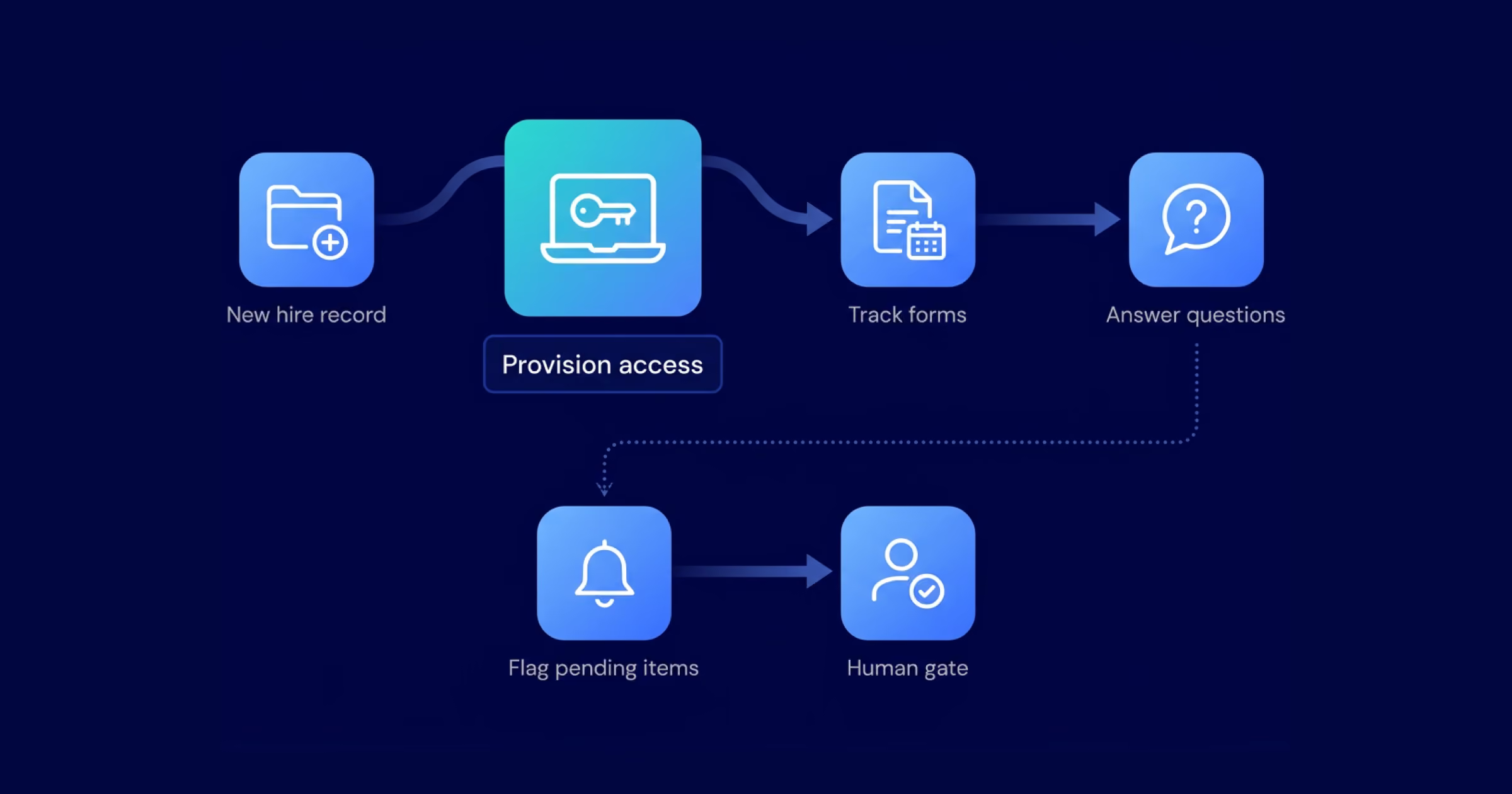
They are structured sequences (triggers, templates) for the repeatable 80% of outreach, with agentic reasoning reserved for research and personalization, and a human gate in front of anything that sends externally or spends budget.
Agentic AI Use Cases in Marketing and Sales
Marketing and sales teams don't adopt agentic AI as one system. They adopt it function by function, starting wherever the volume problem is worst.
Nine of those starting points are documented below, each at working depth. The architecture above stays abstract until it's tied to an actual trigger and an actual system.
Sales Prospecting and Account Research
A rep researching an account by hand checks a handful of sources: the company site, recent news, maybe a LinkedIn post.
This is where agentic AI in sales tends to start, since an agent can check dozens of signals at once and still only surface the accounts actually worth a call.
Agentic AI for sales works best exactly here, at the highest-volume, most repetitive part of the funnel, before it ever touches a live customer conversation.
Outbound Sequencing and Personalized Outreach
A templated cold email gets ignored because it reads like a template. An agent that reads what an account is actually doing can draft an opener that references something real, at a volume no rep could sustain by hand.
The draft still needs a human check before it sends. Personalization built on a wrong or stale signal reads worse than a generic template, since it signals the sender didn't actually check their facts.
Meeting Prep and Call Briefings
A rep walking into a call without reviewing the account's history, prior notes, and recent activity is a worse use of that rep's time than walking in briefed.
An agent that has already reviewed the CRM history, recent emails, and call transcripts can hand the rep a briefing instead of a blank prep window.
The same pattern applies after the call: drafting the follow-up and logging notes, so the rep's attention stays on the conversation rather than the paperwork behind it.
CRM Data Hygiene and Enrichment
A CRM fills with duplicate contacts, stale job titles, and missing fields the moment nobody's actively maintaining it, and every downstream report or campaign inherits that mess.
An agent that continuously checks contact and account records against current data can flag or fix drift as it happens, rather than surfacing the same cleanup project every quarter.
Campaign Performance Monitoring and Optimization
A campaign that starts underperforming on day two often doesn't get caught until the weekly report, by which point the budget's already spent on something that wasn't working.
An agent monitoring spend and performance signals in real time can flag a drop-off or reallocate budget within guardrails a marketer set in advance, instead of waiting for a scheduled review to notice.
Content Generation and Brand Compliance
Drafting is the part of content work most improved by a first pass: a blog outline, an ad variant, a social post draft that a person then edits for voice and accuracy.
The compliance check matters as much as the draft itself.
Claims about a product's performance, pricing, or availability need to be accurate and substantiated before anything publishes, which is why brand and legal review stays in the loop regardless of how good the draft is.
Lead Scoring and Routing
A lead scoring model that only looks at form-fill behavior misses most of what actually predicts whether someone buys: company size, timing, existing relationship with the account.
An agent that correlates a lead against the account's full context, not just its own behavior, routes it to the right rep with the reasoning attached, instead of a raw numeric score nobody can explain.
Renewal and Expansion Signal Detection
A customer heading toward churn usually shows signs before the renewal conversation: declining product usage, a support ticket spike, a champion who left the company.
An agent correlating those signals across product, support, and CRM data can flag an at-risk account to a customer success manager while there's still time to act, instead of surfacing the risk during the renewal call itself.
Agent Identity and Authentication for Marketing and Sales Systems
A prospecting or outreach agent with standing access to the CRM and email systems is a different risk than a rep with the same access, because it acts continuously and can send at a volume no one would notice until it's already a compliance problem.
Implementation: Guardrails and Governance
Gartner's own research, cited earlier, points to escalating costs, unclear business value, and inadequate risk controls as the specific reasons agentic projects get canceled, not a failure of the underlying model.
That gap is closed with the same guardrail layers that apply to any agentic system, made specific to marketing and sales.
One risk is specific to this stack and worth naming directly: outbound communication carries real regulatory exposure.
CAN-SPAM, TCPA, and the FTC's endorsement rules all apply regardless of whether a person or an agent generated the message.
Opt-out handling, calling consent, and substantiated claims all need to hold up the same way they would if a person had written every word by hand.
The Team Behind Production Agentic AI
The genuinely hard question in agentic marketing and sales isn't which model to use. It's deciding, in writing, exactly what an agent owns and what still requires a rep's judgment before anything gets built.
Tecla's Agentic AI services design, build, and operate these workflows directly, the same prospecting, outreach, and campaign systems above, running in your stack with the evals and guardrails production requires.
Or bring the expertise in-house: AI engineers who've worked on live marketing and sales systems, past the demo stage.
Tecla runs a network of senior engineers across the US and Latin America, built over more than a decade, with a top 3% acceptance rate and first candidates in 3 to 5 business days.
FAQ


.png)
.avif)
.avif)