39% of HR professionals report their function has already adopted AI, and 62% say AI is running somewhere in their organization, according to SHRM's State of AI in HR 2026 report, based on a survey of 1,908 HR professionals.
That gap between department-level adoption and organization-wide use is where most HR teams actually sit right now: AI is real and running somewhere nearby, but it hasn't necessarily reached the workflows a given HR team owns directly.
This guide is part of Tecla's Agentic AI Use Cases series, covering agentic AI for HR specifically: the onboarding workflows, benefits patterns, and workforce planning processes that have moved past the pilot stage.
What Is Agentic AI?
Agentic AI refers to goal-oriented systems that plan, execute, and adapt multi-step tasks with minimal human oversight, distinct from traditional automation or generative AI built to answer a single prompt.
Three capabilities define it: autonomy, deciding what actions to take and carrying them out; adaptability, adjusting the plan as new information arrives; and coordination, working across tools and systems to finish what no single tool could handle alone.
In HR, that difference shows up in a new hire's first week. A rules engine sends the same onboarding checklist to everyone.
An agentic system pulls the specific hire's role, location, and benefits elections, and resolves what it can before a generalist ever sees a ticket.
How Agentic Systems Work in HR
HR automation has run on the same model for over a decade, first through employee self-service portals, then through RPA bots handling data entry between the ATS, HRIS, and payroll systems.
RPA automates a predefined, hand-coded sequence: if X, do Y. It is fast and auditable, but it breaks the moment a policy changes or an employee's situation doesn't match the expected template, and every new pattern means someone rewriting the workflow.
Agentic AI operates differently: it reasons instead of just executing a script. It reads the request, decides what context matters, and adjusts its handling as it goes, the way a skilled HR generalist would.
The trade-off is real and worth naming directly: RPA is more predictable and cheaper to audit; agentic systems are more adaptive and more expensive to run per case.
Most production HR deployments in 2026 are not one or the other.
They are structured workflows (routing, matching) for the repeatable 80% of cases, with agentic reasoning reserved for triage and judgment calls, and a human gate in front of anything that touches hiring, pay, or discipline directly.
Agentic AI Use Cases in HR
HR organizations don't adopt agentic AI as one system. They adopt it function by function, starting wherever the volume problem is worst.
Nine of those starting points are documented below, each at working depth, covering the agentic AI HR automation workflows and solutions for HR decision-making that have moved past a pilot and into daily use.
Employee Onboarding and Records Setup
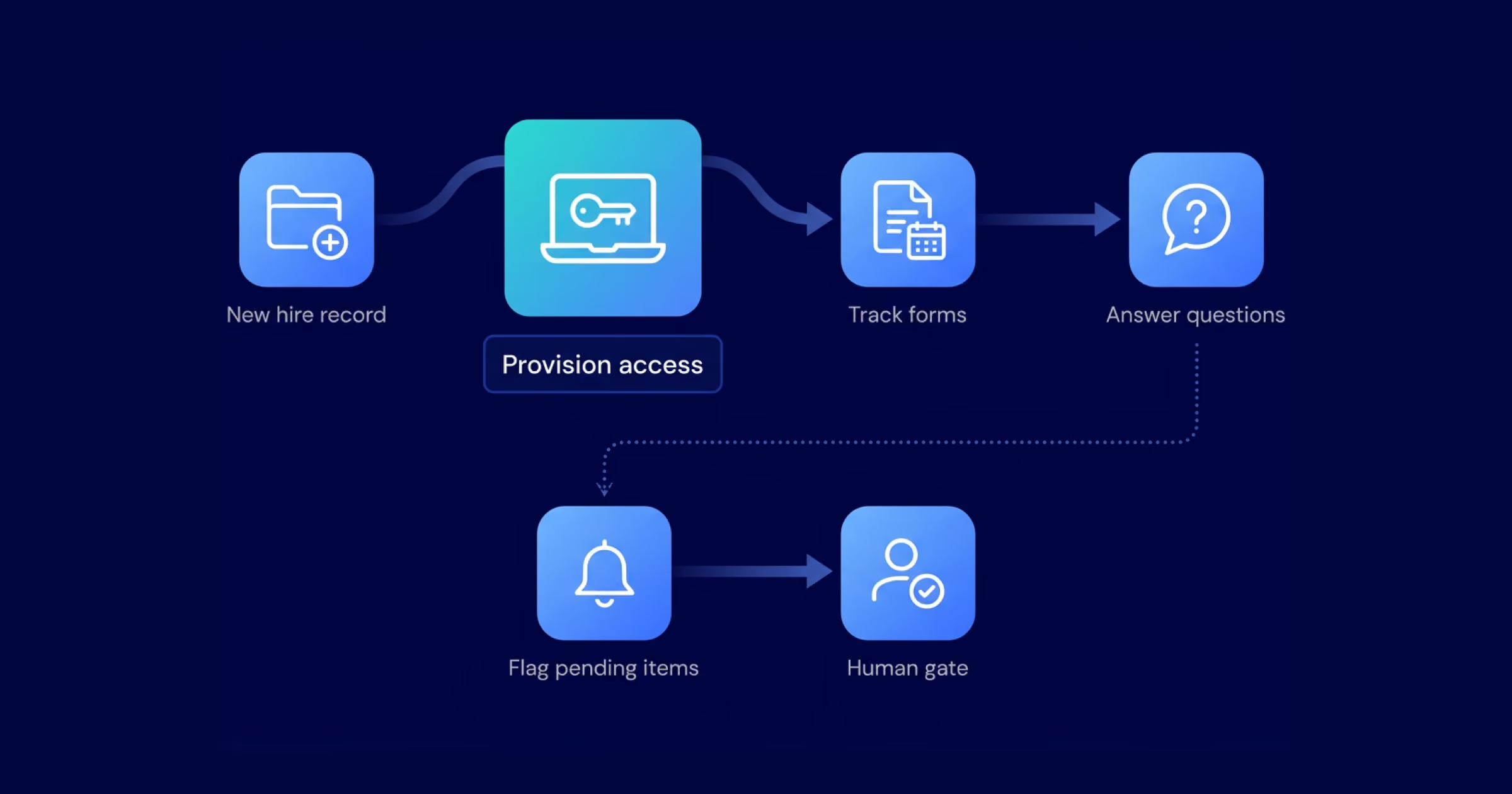
A new hire's first two weeks generate the same set of tasks every time: accounts provisioned, forms signed, benefits elected, equipment ordered, and a stream of small questions that used to all land in the same shared inbox.
HR Helpdesk and Benefits Questions
Most benefits questions are genuinely repetitive: what's covered, when open enrollment closes, how much of a deductible is left. An HR generalist answering the same question for the fiftieth time is not a good use of anyone's time.
Resume Screening and Candidate Sourcing
NYC Local Law 144 requires an independent bias audit for any automated tool that substantially assists hiring decisions, with penalties from $500 to $1,500 per violation. It's been enforced since July 2023, and similar laws are spreading to other states.
Screening tools rank candidates against a role's requirements, surfacing the strongest matches from a large applicant pool rather than a recruiter reading every resume individually.
The ranking has to be explainable, not just accurate, given the audit requirement above.
Interview Scheduling and Coordination
Coordinating a panel interview across four calendars and a candidate's availability is a scheduling problem with enough moving parts that it consistently eats a recruiter's afternoon.
Scheduling agents like Paradox's Olivia handle that coordination directly with the candidate, checking interviewer availability and confirming a time without a recruiter relaying messages back and forth manually.
Performance Review Support and Feedback Synthesis
A manager writing a performance review often has scattered inputs: peer feedback, project notes, prior goals. An agent can pull that context together into a draft, leaving the manager to add judgment rather than start from a blank page.
The rating and the final narrative still belong to the manager. What changes is whether they're synthesizing six months of scattered notes from memory or reviewing a draft that already pulled the relevant ones together.
Workforce Planning and Headcount Analytics
Headcount planning depends on correlating data that usually lives in separate systems: attrition trends, open requisitions, budget constraints, and skills gaps across teams.
An agent that continuously reconciles those sources can flag a coverage gap or a budget risk before it becomes an urgent request, instead of surfacing the same information manually at each quarterly planning cycle.
Employee Relations Case Triage
An employee relations case, a complaint, a conduct concern, a leave dispute, needs context assembled quickly: prior incidents, policy language, and relevant documentation.
An agent can assemble that case file the moment a report comes in, so the HR business partner who owns the case starts with context instead of a blank intake form. The investigation and the outcome still require a person's judgment throughout.
Compliance and Policy Q&A
Questions about I-9 requirements, FMLA eligibility, or state-specific leave policy come up constantly and carry real legal weight if answered incorrectly.
An agent that reads the actual applicable policy, factoring in the employee's state and situation, and cites its source, is safer than a generic script and faster than routing every question to legal or compliance.
Agent Identity and Authentication for HR Systems
HR systems hold some of the most sensitive data in a company: compensation, health information tied to benefits, disciplinary records.
An agent with standing access to that data is a different risk than a person with the same access, because it acts continuously rather than only when someone logs in.
Implementation: Guardrails and Governance
HR teams are moving faster than governance can keep up with. SHRM's own research found that in 52% of organizations, HR has no direct involvement in the company's overall AI strategy, despite being the function most directly reshaped by it.
That gap is closed with the same guardrail layers that apply to any agentic system, made specific to HR.
One risk is specific to this stack and worth naming directly: hiring tools carry legal exposure that most other agentic use cases don't.
NYC Local Law 144 and the state laws following it require an independent bias audit for tools that substantially assist hiring decisions, with published results and real penalties for skipping it.
That obligation applies regardless of how the underlying model was built.
The Team Behind Production Agentic AI
Most HR AI programs stall on data quality, not ambition. An HRIS with years of inconsistent job codes and manager hierarchies is harder to build on than the agent that will eventually query it.
Tecla's Agentic AI services design, build, and operate these workflows directly, the same onboarding, helpdesk, and recruiting systems above, running in your stack with the evals and guardrails production requires.
Or bring the expertise in-house: AI engineers who've worked on live HR systems, past the demo stage.
Tecla runs a network of senior engineers across the US and Latin America, built over more than a decade, with a top 3% acceptance rate and first candidates in 3 to 5 business days.
FAQ


.png)
%20(1).avif)
.avif)
.avif)