68% of real estate agents have used AI in their business, according to the National Association of REALTORS' 2025 Technology Survey. Only 17% call the impact significantly positive. Nearly half, 46%, say it made no noticeable difference at all.
The same survey found eSignature, not AI, is still the most widely used technology in the industry, used by 79% of agents. Real estate runs on paperwork and relationships first, with AI layered in around the edges.
This guide covers agentic AI in real estate specifically: how listing research and transaction paperwork actually work, and why a licensed real estate professional still closes every deal.
What Is Agentic AI in Real Estate?
Agentic AI in real estate is a system that researches listings, comps, and buyer criteria, or prepares transaction paperwork like disclosures and purchase agreements, rather than a real estate professional compiling that material by hand for every deal.
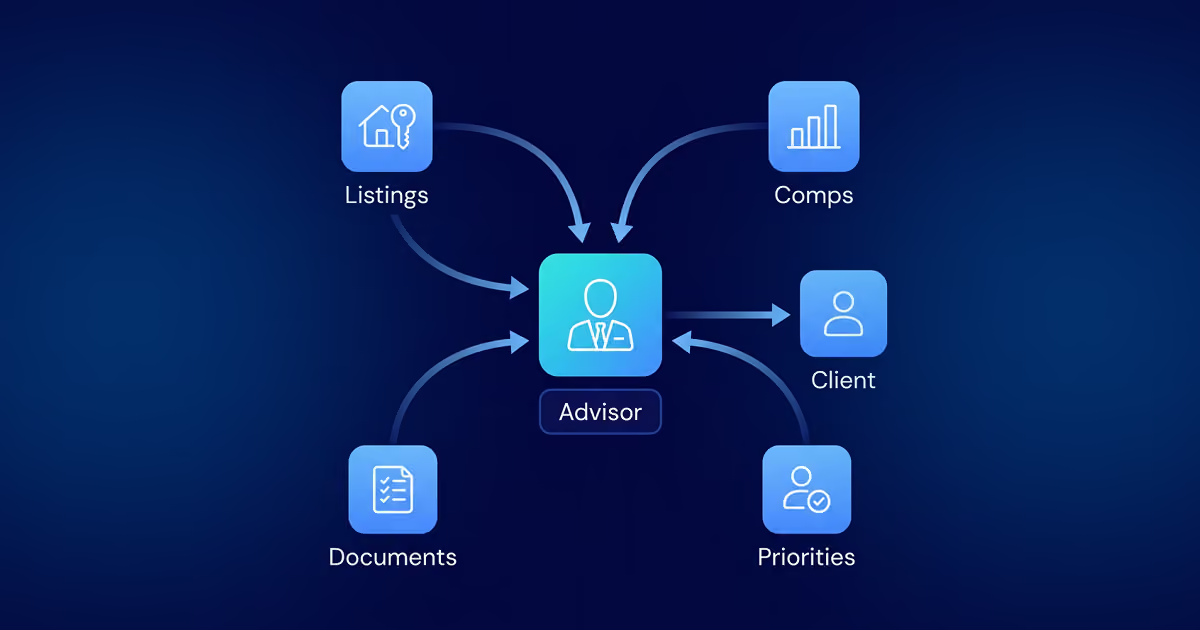
A basic MLS search filters by price range and bedroom count. An agentic system reads what a buyer actually cares about, cross-references it against comparable sales and neighborhood trends, and surfaces a shortlist with the reasoning attached.
None of that removes the real estate professional from the transaction. It changes whether they spend the first hour compiling research or reviewing research someone else's system already assembled.
From MLS Search to Agentic Listing Research
Listing research has run on keyword and filter search for decades: price, bedrooms, square footage, zip code, applied the same way to every buyer regardless of what they actually want.
That filter-based approach misses context a keyword can't capture: a buyer who cares about school district boundaries that don't map cleanly to zip codes, or a property that matches on paper but sits on a busy road nobody mentioned wanting to avoid.
Agentic AI operates differently: it reasons across the buyer's actual stated priorities, recent comparable sales, and neighborhood-level data together, adjusting its recommendations as new listings and new information arrive.
The same shift is happening on the paperwork side. Preparing a purchase agreement or a disclosure packet from scratch for every deal is exactly the kind of repetitive, template-driven work agentic drafting handles well.
A licensed professional still reviews the result before anyone signs.
The Listing Research and Transaction Workflow, Step by Step
The workflow below covers listing research and document preparation together. The sections after it cover fair housing considerations and where a licensed professional's judgment still has to sit.
The workflow
Listing Research: Comps, Market Analysis, Buyer Matching
Pulling comparable sales and building a market analysis by hand takes real time, time that comes directly out of a professional's ability to actually work with clients.
An agent that assembles comps and flags relevant market trends automatically gives a professional a documented starting point, not a finished decision, since a comp's relevance still depends on context a system doesn't always see.
Transaction Paperwork: Disclosures, Contracts, Closing Documents
A purchase agreement or disclosure packet follows a template, but the details, contingencies, deadlines, specific property conditions, have to be exactly right for the specific deal.
An agent drafting from a template and the deal's actual details saves the mechanical assembly work, while the accuracy check before signing stays with the licensed professional whose name and license are on the transaction.
Fair Housing: Why a Professional Still Has to Steer the Conversation
HUD's 2024 guidance confirmed that the Fair Housing Act applies to a housing decision regardless of what technology made it, and that a housing provider stays responsible even when a third-party AI tool is doing the work.
A recommendation engine that quietly steers buyers toward or away from certain neighborhoods based on patterns in its training data creates exactly the liability that guidance addresses, whether or not anyone meant for it to happen.
The Real Estate Professional's Role
The professional's job shifts from compiling every comp and drafting every document from a blank template to reviewing what an agent already assembled, and doing what a system can't: reading a client's actual priorities, negotiating, and closing the deal.
Implementation: Guardrails Specific to Real Estate
Every guardrail below exists because a housing recommendation with no visible reasoning behind it is exactly what fair housing enforcement looks for.
| Layer | What it does | Real estate-specific example |
|---|---|---|
| System prompt | Sets the non-negotiables up front | "Never factor protected-class characteristics into a listing recommendation" |
| Input filters | Block or sanitize out-of-scope requests | Treat buyer criteria as stated preferences to match, not proxies to infer from |
| Tool-call gatekeepers | Cap what actions an agent can take | Research and drafting allowed; presenting to a client always needs a human |
| Output checks | Scan before the action executes | Block any recommendation pattern that correlates with protected characteristics |
| Human-in-the-loop | Requires approval for high-impact actions | A licensed professional reviews every match and every document before use |
Rolling This Out: What to Expect
Start with listing research and comps, a workflow with no direct fair housing exposure on its own, before extending into transaction document drafting.
Audit recommendation patterns periodically for any correlation with protected characteristics, not just for accuracy, since a technically correct match can still create a discriminatory pattern in aggregate.
Expect the paperwork side to need the most review discipline early on, since a document error that reaches a signature is harder to unwind than a listing that simply wasn't the best match.
The Team Behind Production Agentic AI
NAR's own survey found nearly half of agents saw no noticeable impact from AI. The gap between that outcome and a workflow that actually helps usually comes down to whether the system was built around the specific deal, not a generic template.
Tecla's Agentic AI services design, build, and operate this workflow directly, the same listing research and transaction document systems above, running in your stack with the evals and guardrails production requires.
Or bring the expertise in-house: AI engineers who've worked on live real estate systems, past the demo stage.
Tecla runs a network of senior engineers across the US and Latin America, built over more than a decade, with a top 3% acceptance rate and first candidates in 3 to 5 business days.
FAQ


.png)
%20(1).avif)
.avif)
.avif)