In February 2025, a single transmission fault in the Eastern Interconnection caused 1,800 megawatts of AI data center demand to disconnect in milliseconds, according to NERC's own 2026 State of Reliability report.
The same report documents the rare Level 3 reliability alert NERC issued in May 2026, its highest-urgency warning, in response.
AI is now on both sides of the grid reliability story. The computational loads training and running AI models are stressing it in ways NERC is still working out how to model, while agentic AI systems are being built specifically to help monitor and stabilize it.
This guide covers agentic AI in energy specifically: how grid and operations monitoring actually works, and why the systems built for it are deliberately constrained in what they're allowed to do.
What Is Agentic AI in Energy?
Agentic AI in energy is a system that monitors grid and operational data, screens for security risks, and flags anomalies for an operator to review, rather than following a fixed alarm threshold or making changes to live infrastructure on its own.
A traditional SCADA alarm triggers when a measurement crosses a set threshold, and waits for an operator to investigate from there.
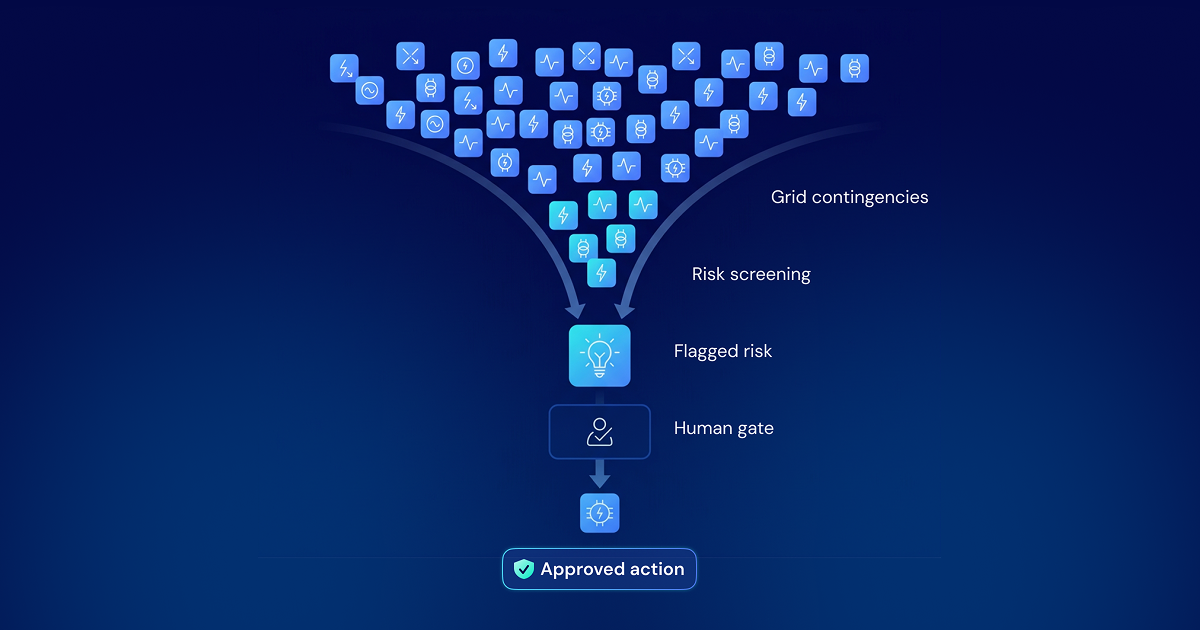
An agentic system reasons across simulation results and contingency scenarios, screening and ranking risks before an operator has to start that analysis by hand.
The distinction matters because grid reliability studies rarely reduce to a single calculation. They require judgment, tool use, and interpretation, exactly the kind of multi-step reasoning agentic systems are built for.
From SCADA Alarms to Constrained-Action Agents
Grid monitoring has run on threshold-based alarms for decades: a voltage or frequency measurement crosses a defined limit, and an alarm fires for an operator to investigate.
That model catches what it's built to catch, a known deviation on a known metric, but it doesn't screen contingencies, rank which risks matter most, or reason across a full simulation the way an engineer studying grid stability would.
Academic researchers building agentic tools for this exact problem, including a benchmark developed with researchers affiliated with PJM Interconnection, define the agent's action space deliberately narrowly.
That means a fixed set of allowed parameters, a capped number of simulations, and files the agent cannot modify.
That constraint isn't a limitation bolted on as an afterthought. It reflects how a human engineer already works: unable to arbitrarily modify a confidential model or ignore an operator's own criteria, even while using every tool available to reach a judgment.
The Grid Anomaly Monitoring Workflow, Step by Step
The workflow below covers contingency screening specifically. The sections after it cover why AI itself has become a new grid stress point, and where an operator's review still has to sit.
The workflow
Why AI Itself Has Become a New Grid Stress Point
NERC's 2026 State of Reliability report documented five separate large-load-loss events tied to computational demand in a single year, including a 1,300-megawatt drop in June 2025 alone.
The concern isn't the AI training itself. It's that these facilities can disconnect from the grid in milliseconds during a routine disturbance, faster than conventional grid modeling was built to anticipate.
That's exactly why NERC is now developing a new registered entity category specifically for large computational loads.
Dynamic Security Risk Screening: What Agentic Grid Tools Actually Do
One of the concrete tasks agentic grid research targets is ranking which short-circuit contingencies out of an entire dataset actually deserve an engineer's attention, using a limited simulation budget rather than running every scenario exhaustively.
A second targets model quality review: checking whether a submitted grid model behaves correctly, diagnosing the specific issue if it doesn't, and recommending a correction within defined limits.
That's the same kind of check an interconnection study requires before a new resource joins the grid.
The Constrained Action Space and Why It Matters
Every credible agentic grid research effort builds the same limitation in by design: a machine-readable file specifying exactly which parameters an agent can touch, how many simulations it can run, and which models stay locked.
That constraint exists because a grid engineer's own authority is constrained the same way. An agent inheriting fewer limits than the person it's assisting would be a mismatch, not an upgrade.
The Grid Operator's Role
The operator's job shifts from manually running every contingency scenario to reviewing what an agent already screened and ranked, and deciding whether a proposed mitigation actually addresses the risk it's tied to.
Implementation: Guardrails Specific to Energy
Every guardrail below exists because a wrong decision on live grid infrastructure carries consequences that most other industries simply don't face at the same scale.
| Layer | What it does | Energy-specific example |
|---|---|---|
| System prompt | Sets the non-negotiables up front | "Never modify a locked grid model or exceed the defined simulation budget" |
| Input filters | Block or sanitize out-of-scope requests | Treat telemetry and event data as signals to evaluate, not commands |
| Tool-call gatekeepers | Cap what actions an agent can take | Screening and ranking allowed; any live infrastructure change needs a human |
| Output checks | Scan before the action executes | Block any ranking or mitigation that can't produce its evidence trail |
| Human-in-the-loop | Requires approval for high-impact actions | A grid operator approves every proposed mitigation before it's applied |
Rolling This Out: What to Expect
Start with anomaly detection and contingency screening on a defined dataset, a workflow with no direct action risk on its own.
Keep the action space narrow and explicit from the start, defined parameters, a capped simulation budget, locked models, rather than expanding an agent's authority before its screening accuracy has been validated.
Expect proposed mitigations to be a later step, one that still requires the same operator review any human-proposed grid change would need.
The Team Behind Production Agentic AI
The hard engineering problem in this space isn't getting an agent to screen contingencies. It's defining the constrained action space precisely enough that the agent's authority actually matches what a grid operator would trust a person with.
Tecla's Agentic AI services design, build, and operate this workflow directly, the same monitoring and screening systems above, running in your stack with the evals and guardrails production requires.
Or bring the expertise in-house: AI engineers who've worked on live energy systems, past the demo stage.
Tecla runs a network of senior engineers across the US and Latin America, built over more than a decade, with a top 3% acceptance rate and first candidates in 3 to 5 business days.
FAQ


.png)
%20(1).avif)
.avif)
.avif)