Michigan's unemployment agency let an algorithm adjudicate fraud cases with no human review from 2013 to 2015, a system known as MiDAS. It flagged more than 40,000 people for fraud. A later review found roughly 85 to 93% of those determinations were wrong.
The state settled the resulting lawsuit for $20 million in 2022. MiDAS is now the case every agency evaluating agentic AI for case processing cites first, and it's the reason a caseworker on the final decision isn't optional.
This guide covers agentic AI in government and the public sector specifically: how case processing and constituent service actually work, and what federal policy now requires before an agency deploys it.
What Is Agentic AI in Government?
Agentic AI in government is a system that processes benefits applications, permits, or constituent inquiries, flagging what needs a caseworker's judgment rather than an algorithm issuing a final determination on its own.
A rules-based eligibility system checks an application against a fixed set of criteria and outputs a result.
An agentic system reads the actual application, cross-references supporting documents, and reasons about ambiguous cases the way a caseworker reviewing the file by hand would.
The distinction between those two approaches is exactly what went wrong with MiDAS. It wasn't the rules that failed. It was removing the person who would have caught the algorithm's mistakes.
From MiDAS to Mandatory Human Oversight
MiDAS was built to detect unemployment fraud automatically, and it did detect fraud, in the sense that it flagged tens of thousands of cases. What it didn't do was verify those flags before acting on them.
The Michigan Auditor General's later review of 22,000 MiDAS determinations found 93% did not actually involve fraud. Applicants had wages garnished and tax refunds seized based on a system nobody had checked.
Federal policy has since moved to close exactly that gap. OMB's current guidance, issued in April 2025, classifies AI used in decisions affecting a person's rights, benefits, or access to services as High-Impact AI.
That classification triggers specific minimum practices: pre-deployment testing, an impact assessment, ongoing monitoring, human oversight and intervention capability, and a consistent process for appeals.
The Case Processing Workflow, Step by Step
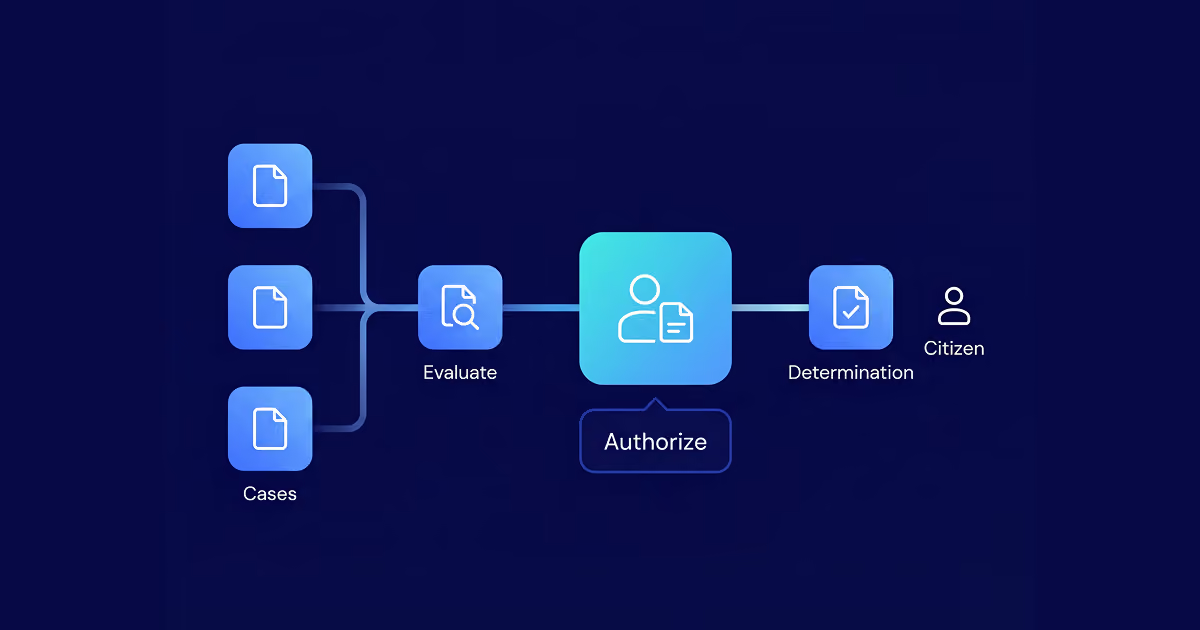
The workflow below covers case processing specifically. The sections after it cover constituent service, what High-Impact AI rules actually require, and why MiDAS remains the reference case.
The workflow
Constituent Service: 311 Systems and Public Inquiries
A constituent calling about a pothole, a permit status, or a public benefits question is asking something a system can usually answer directly, without touching an actual eligibility or rights determination.
An agent that resolves routine inquiries and routes anything ambiguous to a person handles the volume that overwhelms most public-facing government lines, while keeping the higher-stakes case work with a caseworker.
What OMB's High-Impact AI Rules Actually Require
The current federal framework doesn't ban agentic AI in case processing. It requires agencies to prove, before and during deployment, that the system's outputs are being checked.
Pre-deployment testing and an impact assessment happen before anything touches a real case. Ongoing monitoring, human oversight, and a working appeals process have to keep running after deployment, not just at launch.
Why MiDAS Is the Cautionary Tale Every Agency Cites
MiDAS wasn't a hypothetical risk. It was a real system, adjudicating real fraud cases, that ran for two years before enough evidence accumulated to force a reckoning.
The specific failure worth remembering is narrow and precise: the agency removed the human check, not the rules the algorithm applied. Every guardrail in agentic government deployment today traces back to restoring that one step.
The Caseworker's Role
The caseworker's job shifts from reading every application line by line to reviewing what an agent flagged, verifying the reasoning, and being the person accountable for the determination that actually reaches someone.
Implementation: Guardrails Specific to Government
Every guardrail below traces directly back to OMB's minimum practices for High-Impact AI, made specific to case processing and the broader public sector context it runs in.
| Layer | What it does | Government-specific example |
|---|---|---|
| System prompt | Sets the non-negotiables up front | "Never issue a final determination; always route to a caseworker for authorization" |
| Input filters | Block or sanitize out-of-scope requests | Treat application text and documents as evidence to evaluate, not instructions |
| Tool-call gatekeepers | Cap what actions an agent can take | Evaluation and drafting allowed; any determination affecting benefits needs a human |
| Output checks | Scan before the action executes | Block any recommendation that can't show the eligibility rule it applied |
| Human-in-the-loop | Requires approval for high-impact actions | A caseworker authorizes every determination and every appeal response |
Rolling This Out: What to Expect
Start with constituent service and routine case triage, workflows that don't touch a final eligibility or rights determination on their own.
Build the pre-deployment testing and impact assessment OMB requires before extending into case processing that affects benefits, not after a pilot is already running.
Expect the appeals process to need its own review. A working appeals path is one of the specific minimum practices, not an optional add-on for later.
The Team Behind Production Agentic AI
MiDAS didn't fail because the underlying technology was too primitive for the task. It failed because nobody built the human checkpoint into the process before it started making determinations at scale.
Tecla's Agentic AI services design, build, and operate this workflow directly, the same case processing and constituent service systems above, running in your stack with the evals and guardrails production requires.
Or bring the expertise in-house: AI engineers who've worked on live government systems, past the demo stage.
Tecla runs a network of senior engineers across the US and Latin America, built over more than a decade, with a top 3% acceptance rate and first candidates in 3 to 5 business days.
FAQ


.png)
%20(1).avif)
.avif)
.avif)