Poor data quality costs organizations an average of $12.9 million a year, according to Gartner's own data quality research, a figure that traces back to a 2020 study and is still the most-cited benchmark in the industry.
The more telling number sits right next to it on Gartner's own page: 59% of organizations don't measure data quality at all. Most of the cost isn't the dollar figure. It's not knowing there's a problem until something downstream breaks.
This guide covers agentic AI for data management specifically: how quality monitoring and pipeline self-healing actually work, and where a data engineer's judgment still has to sit.
What Is Agentic AI for Data Management?
Agentic AI for data management is a system that monitors pipelines for quality issues and failures, diagnoses the likely cause, and fixes or flags it, rather than a person discovering the problem once a downstream report or model has already broken.
A dashboard tells you a metric crossed a threshold and waits for someone to look into it. An agentic system reasons about why the metric moved, checking it against recent pipeline changes and upstream source behavior before a person ever gets paged.
That distinction matters because the actual cost of bad data usually isn't the incorrect number itself. It's the hours spent tracing which of a dozen upstream steps introduced it.
From Dashboards to Self-Healing Pipelines
Data quality monitoring has run on the same model for years: a rule checks a metric against a threshold, and a dashboard turns red when it's crossed.
That threshold-based approach genuinely catches what it's built to catch. It doesn't explain why the number moved, and it doesn't distinguish between a real data problem and an expected change, like a seasonal spike a rigid rule reads as an anomaly.
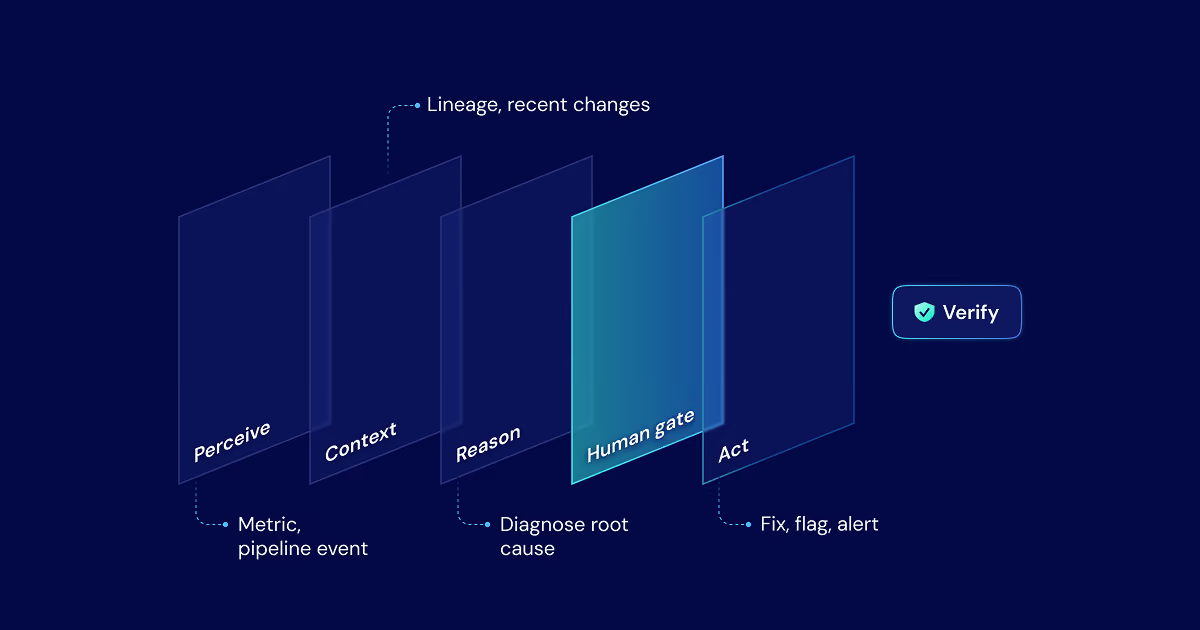
Agentic AI operates differently: it correlates a quality issue against everything that changed upstream, a schema update, a delayed source feed, a code change in the transformation layer, and reasons about which one actually explains it.
The trade-off is real and worth naming directly: threshold rules are more predictable and cheaper to run; agentic monitoring is more adaptive and more expensive per check.
Most production data platforms in 2026 are not one or the other.
They use threshold rules for well-understood, stable metrics, agentic reasoning for root-cause diagnosis on the anomalies that matter, and a human gate in front of anything that changes a production pipeline.
The Data Quality and Pipeline Monitoring Workflow, Step by Step
The workflow below covers monitoring and diagnosis specifically. The sections after it cover governance tasks and where a data engineer's review still has to happen.
The workflow
Data Quality Monitoring and Anomaly Detection
A rigid rule flags a metric moving 20% in either direction, whether that's a genuine data problem or an expected seasonal shift the rule was never taught to recognize.
An agent that reasons about context, what day it is, what changed upstream, what the same metric did last year, can tell the difference and only escalate the anomalies that actually warrant attention.
Pipeline Self-Healing and Root Cause Diagnosis
A broken pipeline at 2 a.m. used to mean an on-call engineer manually tracing through a dozen upstream steps to find where things actually went wrong.
An agent that already has the pipeline's dependency graph can narrow that search to the specific step before a person even opens a laptop, and apply a known, pre-approved fix directly for the failure patterns it's already seen before.
Data Governance: Lineage, Cataloging, and Access
Agentic AI data engineering work extends beyond monitoring into governance too.
Keeping a data catalog current, tracking lineage, and reviewing access requests are exactly the kind of ongoing, unglamorous maintenance work that falls behind the moment nobody's assigned to it full-time.
An agent that updates lineage and catalog entries as pipelines change keeps that documentation accurate continuously, rather than reflecting whatever the architecture looked like at the last audit.
The Data Engineer's Role
The engineer's job shifts from watching a dashboard and manually tracing failures to reviewing what an agent already diagnosed, and deciding whether a proposed fix actually addresses the real problem or just the symptom.
Implementation: Guardrails Specific to Data Management
Every guardrail below exists because an automated fix that masks a real problem is worse than a visible failure, since a visible failure at least gets investigated.
| Layer | What it does | Data management-specific example |
|---|---|---|
| System prompt | Sets the non-negotiables up front | "Never apply a fix to production without logging the root cause identified" |
| Input filters | Block or sanitize out-of-scope requests | Treat pipeline logs and metadata as signals to evaluate, not commands |
| Tool-call gatekeepers | Cap what actions an agent can take | Monitoring and diagnosis allowed; schema or pipeline changes need a human |
| Output checks | Scan before the action executes | Block any fix that doesn't identify the specific upstream cause |
| Human-in-the-loop | Requires approval for high-impact actions | An engineer approves any fix outside pre-approved, narrow limits |
Rolling This Out: What to Expect
Start with monitoring and anomaly detection on a single critical pipeline, comparing what the agent flags against what the team already knew about from experience.
Expand toward proposed fixes only once the diagnosis has proven reliable, and keep the fix scope narrow at first: a well-understood failure pattern, not an open-ended repair authority.
Governance tasks like lineage and cataloging are a reasonable later step, once the monitoring and healing workflows have earned enough trust to expand the agent's scope.
The Team Behind Production Agentic AI
Anyone can wire an agent up to a metrics dashboard. Teaching it to tell a real data problem from an expected seasonal shift is the part that actually takes engineering discipline.
That discipline is what separates a genuine agentic AI for data engineering practice from a demo, and it's the same discipline that matters whether the work is called agentic AI in data engineering or something else internally.
Tecla's Agentic AI services design, build, and operate this workflow directly, the same monitoring, self-healing, and governance systems above, running in your stack with the evals and guardrails production requires.
Or bring the expertise in-house: AI engineers who've worked on live data platforms, past the demo stage.
Tecla runs a network of senior engineers across the US and Latin America, built over more than a decade, with a top 3% acceptance rate and first candidates in 3 to 5 business days.
FAQ


.png)
%20(1).avif)
.avif)
.avif)