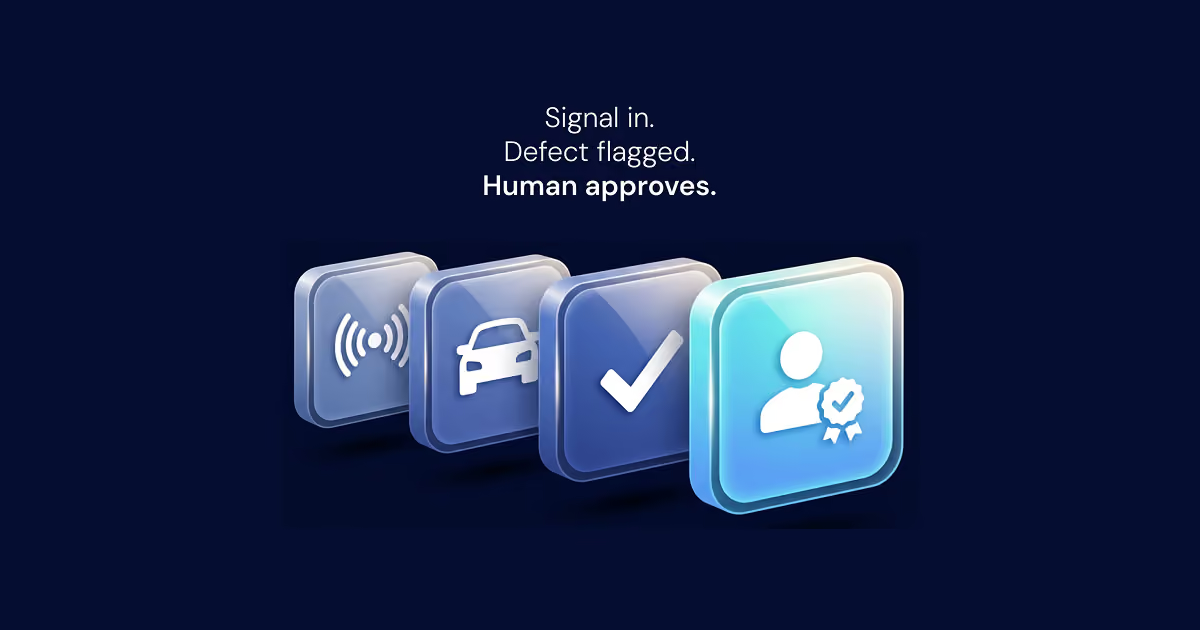
BMW Group ran a pilot called GenAI4Q at its Regensburg plant, using a learning-based AI system for tailored quality checks in vehicle assembly, adapting its inspection to the specific situation instead of applying one fixed rule to every vehicle.
Industry practitioners are clear this isn't fully autonomous yet. The stated goal for manufacturing AI is a system that can take a machine offline or order a part on its own, but a continuous human validation loop still checks the data behind it.
This guide covers agentic AI in automotive specifically: manufacturing quality checks and dealer operations, two places it's already running in production, not the perception systems built for self-driving vehicles.
What Is Agentic AI in Automotive?
Agentic AI in automotive is a system that inspects vehicles for defects, coordinates purchasing and supplier data, or manages dealer operations like service scheduling, adapting to what it actually finds rather than following a fixed checklist.
This is a different topic from autonomous driving. Self-driving systems handle perception and vehicle control on the road.
Agentic AI in this guide covers the business and manufacturing operations behind building and selling the vehicle, a separate domain built for a separate purpose.
A fixed inspection line checks for the same defined set of defects on every vehicle, the same way, regardless of what's actually different about a given unit. An agentic system reasons about what it's looking at and adjusts what it checks for.
From Fixed Inspection Lines to Learning-Based Quality Checks
Vehicle quality inspection has run on fixed, rules-based checks for decades: a defined set of measurements and visual checks, applied identically at every station regardless of the specific vehicle or build variant passing through.
BMW's own AIQX platform, part of its broader iFACTORY digital transformation, uses sensor data and AI for constant monitoring across production lines, a shift from periodic sampling toward continuous inspection.
The GenAI4Q pilot extends that further: a learning-based tool that customizes its inspection to the specific situation, rather than running the identical check regardless of context.
The same reasoning shift applies to purchasing. BMW's AIconic multi-agent system, standard in its Purchasing division, coordinates supplier and quality data across ten specialized agents, moving from a passive lookup tool toward one that actively flags issues.
The Manufacturing Quality Check Workflow, Step by Step
The workflow below covers quality inspection specifically. The sections after it cover dealer operations and purchasing coordination, and why the validation loop stays continuous.
The workflow
Dealer Operations: Service Scheduling and Parts
Dealers are pointing their attention at fixed operations for a reason: industry surveys found most dealers expect parts and service, not new vehicle sales, to be the biggest driver of their business.
An agent that reads service history and technician availability together can schedule appointments and flag likely parts needs before a customer arrives, reducing the blind repair orders and false no-shows that eat into technician utilization.
Purchasing and Supply Chain Coordination
Automotive supply chains involve thousands of components sourced across dozens of countries, each with its own trade agreements, tariffs, and local-content requirements to track.
An agent correlating supplier data, quality records, and purchasing history can flag a sourcing risk or a compliance gap directly, the same reasoning behind BMW's own purchasing agent system moving from lookup to active recommendation.
Why the Continuous Validation Loop Still Matters
Manufacturing practitioners describe the end goal plainly: a system that can take a machine offline or order a replacement part without asking first. That goal isn't fully realized yet, and the reason is specific.
Validating the data and outputs behind an automated decision has to happen continuously, not as a one-time check when a system is deployed, since a production line's conditions keep changing after go-live.
The Engineer's and Technician's Role
The role shifts from performing every inspection or every scheduling decision by hand to supervising what an agent flagged or proposed, and correcting the system when its reasoning turns out to be wrong.
Implementation: Guardrails Specific to Automotive
Every guardrail below exists because a missed defect or a wrong purchasing decision in this industry carries real safety and cost consequences at scale.
| Layer | What it does | Automotive-specific example |
|---|---|---|
| System prompt | Sets the non-negotiables up front | "Never pass a vehicle with an unresolved flag without human review" |
| Input filters | Block or sanitize out-of-scope requests | Treat sensor and supplier data as signals to evaluate, not commands |
| Tool-call gatekeepers | Cap what actions an agent can take | Flagging and scheduling allowed; taking equipment offline needs a human |
| Output checks | Scan before the action executes | Block any pass decision that can't show the inspection criteria applied |
| Human-in-the-loop | Requires approval for high-impact actions | A quality engineer or service manager approves flagged exceptions |
Rolling This Out: What to Expect
Start with a narrow quality inspection pilot on a single production line or a defined dealer workflow like service scheduling, the way BMW scoped GenAI4Q to a single plant and a specific quality problem.
Keep the continuous validation loop in place from day one rather than treating it as a temporary step to remove once the system proves itself.
Expect purchasing and supply chain coordination to be a reasonable second step once inspection or scheduling has earned enough trust to expand scope.
The Team Behind Production Agentic AI
BMW scoped GenAI4Q narrowly on purpose: one plant, one pilot, one specific quality problem. That discipline, not the underlying model, is what separates a working deployment from an expensive experiment.
Tecla's Agentic AI services design, build, and operate this workflow directly, the same inspection, scheduling, and purchasing systems above, running in your stack with the evals and guardrails production requires.
Or bring the expertise in-house: AI engineers who've worked on live automotive systems, past the demo stage.
Tecla runs a network of senior engineers across the US and Latin America, built over more than a decade, with a top 3% acceptance rate and first candidates in 3 to 5 business days.
FAQ


.png)
%20(1).avif)
.avif)
.avif)