THE SHORT VERSION
An AI agent is a discrete system built to do one thing autonomously. Agentic AI is a property of systems that reason, plan, and act across many steps without hand-holding. The terms get used interchangeably, but the distinction changes how you build and who you need to hire.
Every major SaaS vendor and fintech platform is now shipping something with the word “agent” in the name. The term has enough momentum that it is being applied to everything from a simple LLM wrapper that answers support tickets to a multi-step autonomous system that can read a contract, flag risk, and route the document for review.
The distinction matters more than most teams realize. Building the wrong architecture for the wrong problem is recoverable. Hiring engineers who cannot tell the difference is not, at least not without significant cost. This piece defines both terms clearly and explains what each pattern demands from your stack and your team.
What Is an AI Agent?
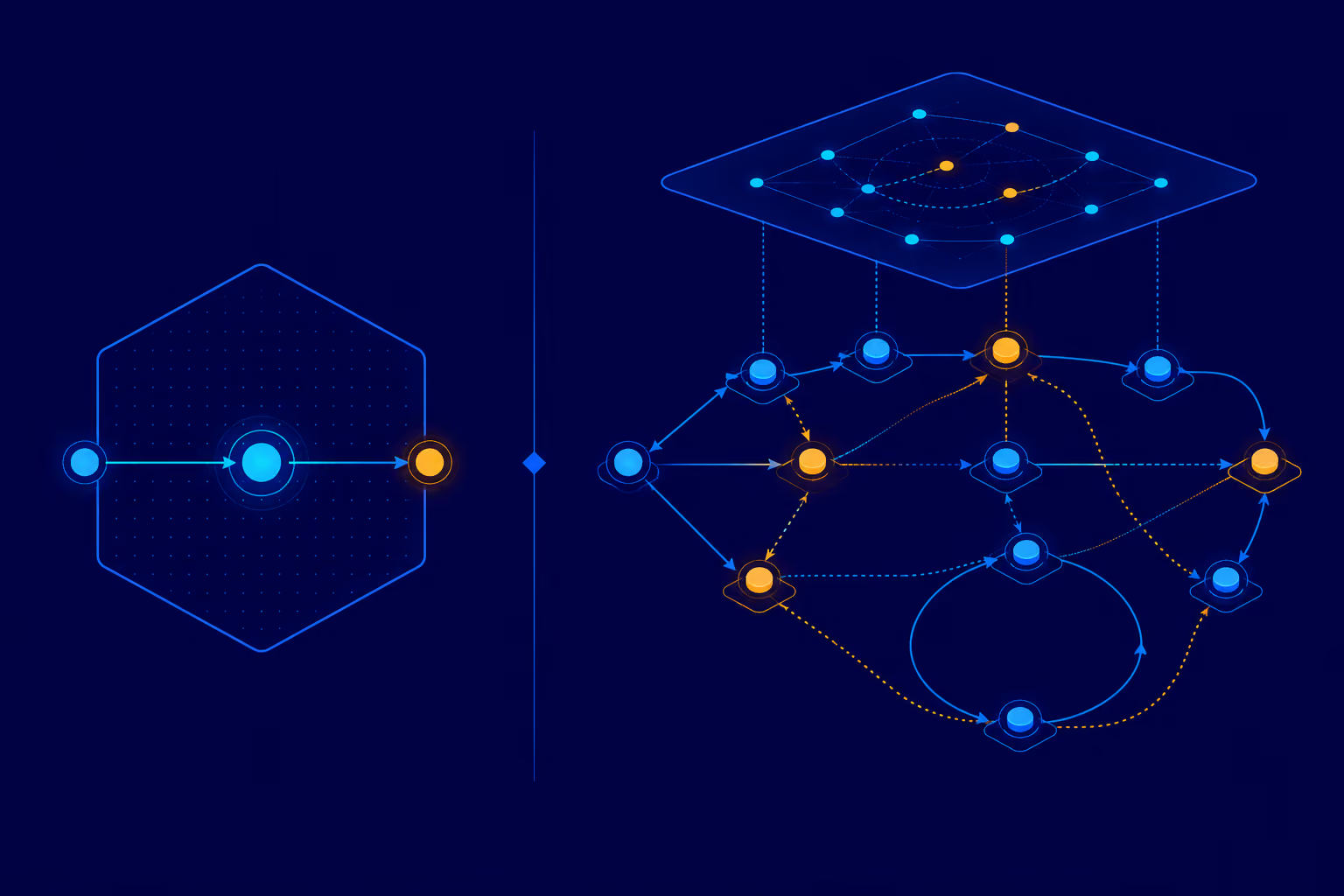
An AI agent is a software system that perceives inputs, reasons about them, and takes actions toward a defined goal, without a human directing each step. The operative word is discrete. An agent is built for a specific scope: it has a task, a set of tools it can use, and a boundary around what it is allowed to do.
In SaaS, a well-scoped AI agent might monitor a payment pipeline, detect anomalies, and trigger an alert without waiting for a human to notice. In fintech, an agent could review a loan application against a defined ruleset and surface a recommendation. It is not improvising. It is executing within a fixed decision space.
What Is Agentic AI?
Agentic AI describes a system's capacity for autonomous, multi-step decision-making, where the system does not just execute a task but determines which tasks to pursue and in what order, based on what it has observed. The system plans, acts, reflects, and adapts without a human in the loop at each step.
In SaaS, agentic AI shows up in products that manage workflows end-to-end: onboarding users, surfacing upsell moments, monitoring health metrics, and escalating to a human only when a threshold is crossed. The hard part is not building the steps. It is building the reasoning layer that decides which steps matter and when.
AI AGENT
A discrete, task-scoped system that acts autonomously within defined boundaries.
It perceives inputs, selects from available tools, and executes toward a fixed goal. Scope is constrained by design.
AGENTIC AI
A system property: the capacity to reason, plan, and act across multiple steps with minimal human input.
Not a single agent. A design philosophy. The system decides what to do next based on what it has already learned.
Where AI Agents and Agentic AI Overlap
WORTH CLARIFYING
AI agents and agentic AI overlap because agentic systems are usually built from multiple agents working in sequence or parallel. An agent can be a component inside an agentic system. The confusion comes from using the two terms interchangeably, when they actually describe different levels of abstraction.
A single well-scoped agent is not agentic on its own. Agentic behavior emerges when a system can determine its own next step. If every action still needs a human decision, the system has agents but is not agentic.
AI Agents vs Agentic AI: Architecture and Stack Differences
The gap between the two patterns is not just conceptual. It changes what you need to build and what can go wrong at scale.
|
AI Agents |
Agentic AI Systems |
| Architecture |
Single-purpose module with defined tools and scope |
Multi-component orchestration with planning and memory layers |
| State management |
Stateless or session-scoped |
Persistent state across sessions and decision cycles |
| Failure mode |
Predictable, scope limits blast radius |
Harder to trace, errors compound across reasoning steps |
| Observability |
Standard logging and monitoring |
Requires tracing reasoning chains, not just outputs |
| Compliance fit |
Easier to audit, decision paths are fixed |
Requires explainability layer; harder in regulated environments |
| SaaS / fintech fit |
Support automation, alerting, document processing |
End-to-end workflow automation, adaptive user journeys |
For fintech teams, the compliance implications make this distinction architectural, not semantic. An agent that flags a suspicious transaction has an auditable decision log. An agentic system that decides which transactions to review, and in what order, needs a different kind of explainability.
When to Use AI Agents vs Agentic AI in SaaS and Fintech
The right choice depends on the task structure: how many steps it takes, whether the system needs to call external tools, and how much human oversight the workflow can tolerate.
| Use case |
AI Agent |
Agentic AI |
| Transaction monitoring (fintech) |
Strong fit
Flags anomalies against fixed rules. Auditable, scoped, fast to deploy.
|
Possible
Useful if risk scoring needs to adapt across review cycles, but adds explainability burden.
|
| Customer onboarding (SaaS) |
Possible
Can handle a single onboarding step, like document verification, in isolation.
|
Strong fit
Manages the full journey end to end: nudges, escalation, and adapting to user behavior.
|
| Support ticket triage |
Strong fit
Classifies and routes tickets against a defined taxonomy. Predictable and easy to monitor.
|
Possible
Fully autonomous resolution across multiple systems, but requires strong guardrails.
|
| Loan underwriting workflow (fintech) |
Possible
Can score a single application against a ruleset, but cannot adapt the workflow itself.
|
Strong fit
Coordinates document review, compliance checks, and routing as one adaptive sequence.
|
| Multi-system orchestration |
Not suited
A single-scope agent cannot coordinate across CRMs, billing, and data systems on its own.
|
Strong fit
Built for exactly this: planning and sequencing actions across multiple connected systems.
|
Common Agentic AI Tools and Frameworks
Most agentic systems are built on top of one of a handful of orchestration frameworks. Each takes a different approach to memory, planning, and tool access.
| Framework |
Primary use |
Best for |
| LangChain |
Orchestration framework for LLM-powered agents |
Teams building custom agentic pipelines with tool and memory support |
| AutoGen |
Multi-agent conversation and task execution |
Workflows where multiple agents need to collaborate on one problem |
| CrewAI |
Role-based multi-agent workflows |
Structured agent teams with defined roles and handoffs |
| OpenAI Assistants API |
Stateful agents with built-in tool calling |
Teams already in the OpenAI ecosystem needing persistent threads |
| Claude (Anthropic) |
Long-context reasoning and tool use |
Agents that need deep document analysis and reliable instruction following |
| LlamaIndex |
Data-aware agent workflows |
Agents that retrieve and act on large structured or unstructured data sets |
Why the AI Agents vs Agentic AI Distinction Matters for Hiring
The engineers who can wire up a single-task agent are not the same engineers who can design an agentic system, and the hiring market rarely makes that distinction. Job descriptions ask for “AI experience” without specifying which layer, so candidates who shipped one well-scoped agent present the same way as engineers who built reasoning systems from scratch.
This is where Tecla's vetting process is built differently. We screen for how a candidate has actually used AI across architecture, tooling, and execution. That distinction is what separates a team that ships a working agent from one that ships an agentic system that holds up under real load and compliance scrutiny.
The engineers moving AI products forward think in systems, not just prompts.
We connect you with engineers who have adapted their workflows to the reality of AI development.
Talk to Us
Frequently Asked Questions
Are AI agents and agentic AI the same thing?
No. An AI agent is a discrete system built to execute a specific task autonomously. Agentic AI is a property of systems that can reason, plan, and act across multiple steps without human direction at each stage. An agentic system is often composed of multiple agents, but a single agent operating within a fixed scope is not agentic on its own.
What is an example of an AI agent in fintech?
A common example is a transaction monitoring agent that watches a payment stream, applies a defined set of rules, and triggers an alert or block when a threshold is crossed. It is not deciding which rules to apply, it executes within a pre-defined decision space. The scope is fixed by design, which is what makes it auditable and easier to deploy in regulated environments.
What does agentic AI look like in a SaaS product?
An agentic SaaS system might manage an onboarding workflow end-to-end: identifying where a user is in the journey, deciding which nudge to send, monitoring engagement, adjusting the sequence based on behavior, and escalating to a human only when the system determines intervention is warranted. The system decides what to do next rather than executing a fixed playbook.
Do I need different engineers to build agentic systems versus AI agents?
In practice, yes. Building a well-scoped agent requires strong LLM integration skills and solid prompt engineering. Designing an agentic system requires experience with orchestration, multi-step reasoning, memory architecture, and failure tracing across decision chains. The profiles overlap at the edges but are meaningfully different at seniority and depth. Hiring for “AI experience” without specifying which layer leads to mismatched expectations on both sides.
How do I assess whether a candidate can actually build agentic systems?
The signal is in how they describe past work, not just what they claim to have shipped. Engineers who have designed agentic systems talk about how they handled state across sessions, how they traced reasoning failures, and what they learned about where the planning layer broke under real conditions.



.png)
%20(1).avif)
.avif)
.avif)