78% of manufacturers name trade uncertainty as their top concern, and expect input costs to rise 5.4% over the next year, according to Deloitte's 2026 Manufacturing Industry Outlook.
That's exactly the kind of volatility agentic AI supply chain tools are being built to sense and respond to: tariff shifts, supplier disruptions, and demand swings that used to surface as a surprise, now caught earlier because something is watching continuously.
This guide is part of Tecla's Agentic AI Use Cases series, covering agentic AI for supply chain and manufacturing specifically: the maintenance workflows, sourcing patterns, and production processes that have moved past the pilot stage.
What Is Agentic AI?
Agentic AI refers to goal-oriented systems that plan, execute, and adapt multi-step tasks with minimal human oversight, distinct from traditional automation or generative AI built to answer a single prompt.
Three capabilities define it: autonomy, deciding what actions to take and carrying them out; adaptability, adjusting the plan as new information arrives; and coordination, working across tools and systems to finish what no single tool could handle alone.
On a factory floor, that difference shows up in how equipment failure gets caught. A fixed maintenance schedule services equipment on a calendar, whether it needs it or not.
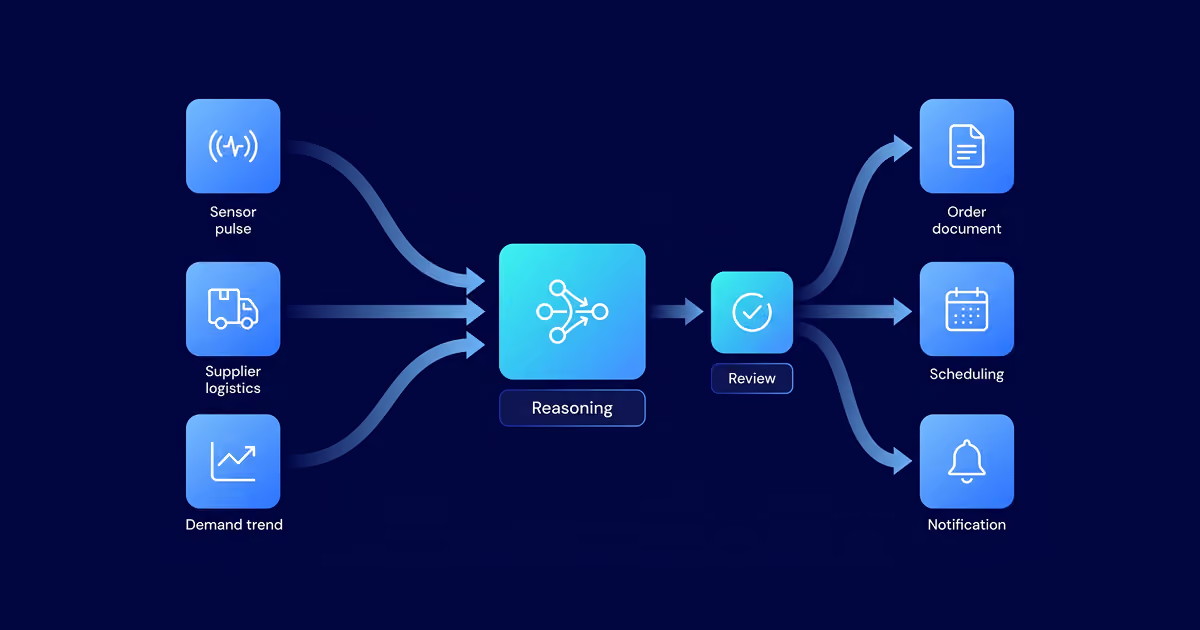
An agentic system reads live sensor data and flags the specific machine actually showing signs of wear, before the schedule would have caught it.
How Agentic Systems Work in Supply Chain and Manufacturing
Manufacturing has run on automation for decades, first through fixed production-line sequencing, then through scheduled maintenance and statistical demand planning layered on top.
That scheduled approach follows a fixed calendar: service this equipment every ninety days, reorder this material at this threshold, regardless of what's actually happening on the line or in the supply base.
Agentic AI operates differently: it reasons across live signals instead of a fixed calendar. It reads sensor data, supplier conditions, and demand together, and adjusts its recommendation as those conditions change.
The trade-off is real and worth naming directly: scheduled maintenance and planning are more predictable and cheaper to audit; agentic systems are more adaptive and more expensive to run per decision.
Most production deployments in 2026 are not one or the other.
They use scheduled processes for stable, well-understood equipment and materials, agentic reasoning for anomaly detection and disruption response, and a human gate in front of anything that touches safety, cost commitments, or a supplier relationship.
Agentic AI Use Cases in Supply Chain and Manufacturing
Manufacturers don't adopt agentic AI as one system. They adopt it function by function, starting wherever the volume problem or the disruption risk is worst.
Nine of those starting points are documented below, each at working depth. The architecture above stays abstract until it's tied to an actual trigger and an actual system.
What follows covers the use cases in manufacturing and applications in manufacturing that have moved past a pilot and into daily use, not just what's technically possible.
Predictive Maintenance
Unplanned downtime on a production line costs far more than the repair itself, once lost output and delayed orders are counted in.
Demand Forecasting and Production Planning
Production planning has a different shape than retail demand forecasting: it's less about a single SKU on a shelf and more about raw materials, capacity, and labor all lining up together weeks in advance.
An agent that correlates order backlogs, material lead times, and floor capacity can flag a coming bottleneck before it hits, instead of a planner discovering the mismatch once it's already too late to adjust.
Supply Chain Risk Monitoring and Disruption Response
Deloitte's own 2026 outlook describes agents that monitor Tier 1 and Tier 2 suppliers for disruption risk tied to trade policy, tariffs, or weather, and quantify the likely cost and delay impact before a person ever asks.
The same agents can recommend alternative suppliers that balance risk and cost, and initiate mitigation steps like contract renegotiation, always with a human approving the actual commitment.
Supplier Discovery and Sourcing
Finding a new supplier fast, after a disruption, usually means someone scrambling through a contact list under pressure rather than making a considered decision.
An agent that already has candidate suppliers evaluated against cost, capacity, and risk criteria can surface real alternatives immediately, giving a sourcing team a starting point instead of a blank search.
Quality Control and Defect Detection
A human inspector checking every unit on a fast-moving line inevitably misses some defects, simply from the volume and the fatigue of doing it all day.
An agent reasoning over visual inspection data can catch a defect pattern consistently at line speed, flagging genuinely ambiguous cases for a person rather than either missing them or stopping the line for everything.
Institutional Knowledge Capture and Workforce Onboarding
A retiring machinist's twenty years of tacit knowledge about a specific piece of equipment usually leaves with them, undocumented, unless someone specifically sits down to capture it.
Deloitte's outlook names this directly as an agentic AI use case: capturing that institutional knowledge and generating standard operating procedures from it, accelerating onboarding for whoever takes the role next.
Production Scheduling and Shift Handover
A shift handover done poorly means the incoming team spends the first hour reconstructing what happened on the last shift instead of starting where the previous one left off.
An agent that generates the handover report and updated work instructions automatically, according to Deloitte's outlook, maximizes uptime by making that transition close to instant instead of a manual reconstruction each time.
Warranty and Service-Level Management
Deloitte's outlook also names aftermarket service as an agentic opportunity: evaluating telemetry data on industrial equipment to detect misuse, validate a warranty claim, and even approve or reject it, rather than a claims adjuster starting from a paper form.
The same reasoning can dynamically adjust a service-level agreement based on how hard a piece of equipment is actually being used, upgrading a heavily used machine to priority servicing before it becomes a breakdown.
Agent Identity and Authentication for Supply Chain and Manufacturing Systems
An agent with standing access to supplier contracts, production schedules, and industrial control systems is a different risk than a planner with the same access, because it acts continuously and touches systems where a mistake can be physical, not just financial.
Implementation: Guardrails and Governance
Deloitte's own research frames the requirement plainly: manufacturers moving from pilots to full-scale agentic AI need to account for cost, talent, data, technology, governance, and workflow transformation together, not just the model.
That gap is closed with the same guardrail layers that apply to any agentic system, made specific to supply chain and manufacturing.
The Team Behind Production Agentic AI
Building agentic AI for manufacturing means connecting an agent safely to operational technology that was never designed to be queried, let alone acted on. That's the harder engineering problem here, not the underlying model.
Tecla's Agentic AI services design, build, and operate these workflows directly, the same maintenance, sourcing, and production systems above, running in your stack with the evals and guardrails production requires.
Or bring the expertise in-house: AI engineers who've worked on live supply chain and manufacturing systems, past the demo stage.
Tecla runs a network of senior engineers across the US and Latin America, built over more than a decade, with a top 3% acceptance rate and first candidates in 3 to 5 business days.
FAQ


.png)
%20(1).avif)
.avif)
.avif)