General partners report the highest returns from generative AI in deal sourcing and due diligence, according to a joint 2026 survey by Bain & Company and StepStone Group.
Inside their own portfolio companies, the picture is far less certain. Nearly 40% of GPs surveyed don't expect AI to have a material financial impact there this year at all.
This guide covers agentic AI in private markets specifically, building on the research pattern already outlined in Tecla's Agentic AI in Finance and Banking guide: how diligence and data room review actually work, and where the returns are still unproven.
What Is Agentic AI in Private Markets?
Agentic AI in private markets is a system that reads data room documents or portfolio company data, flags the risks and inconsistencies that matter to a specific deal, and synthesizes findings for a deal team to review.
Whether a given firm calls this agentic AI in private equity or agentic AI in private capital depends more on which side of the fund structure is asking than on what the workflow actually does.
A keyword search finds a document containing a specific term. An agentic system reads what a contract, a financial model, or a customer concentration schedule actually says, and cross-references it against everything else in the room.
That distinction matters because the risks that actually kill deals rarely announce themselves. They show up as a discrepancy between two documents nobody thought to compare, or a clause buried on page forty of an agreement nobody expected to matter.
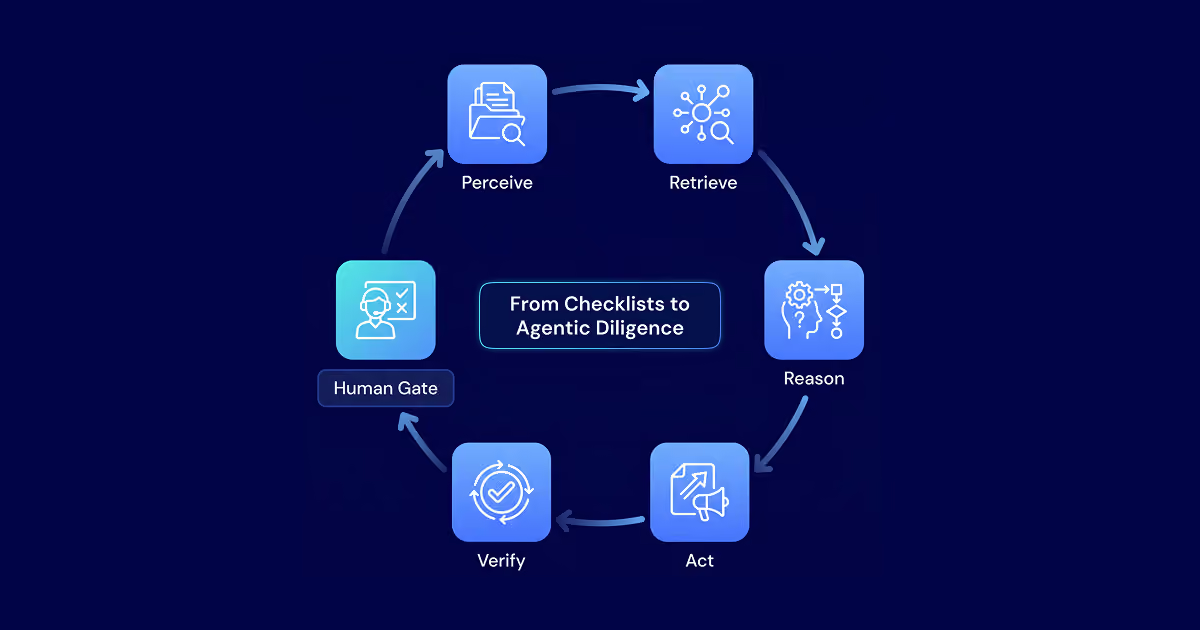
From Checklists to Agentic Diligence
Diligence has run on standardized checklists for decades: a fixed list of document categories, a fixed set of questions for management, applied the same way regardless of what a specific deal actually looks like.
That checklist approach catches what it was built to catch. It doesn't catch the deal-specific risk that doesn't fit a category, or the pattern that only becomes visible once someone actually reads every document in a room, not just the ones flagged as important.
Agentic AI operates differently: it reads the entire data room and reasons about what's actually relevant to this specific target, the way a sharp associate would if given unlimited time to read everything.
Bain's own framing captures why that speed matters more now than it used to: a deal that needed roughly 5% annual EBITDA growth to deliver a strong return a decade ago now needs closer to 10 to 12%, since multiple expansion and cheap debt no longer do the work.
The Diligence and Data Room Review Workflow, Step by Step
The workflow below covers data room review specifically. The sections after it cover portfolio monitoring, why its returns are less certain, and where a deal team's judgment still sits.
Data Room Review at Deal Speed
A data room for a mid-size target can run into thousands of documents, and reading all of them closely within a tight exclusivity window is exactly the volume problem agentic review is built for.
The value isn't just speed. It's catching the specific inconsistency between a customer contract and a revenue schedule that a person skimming under deadline pressure would plausibly miss.
Portfolio Monitoring: Where AI's Impact Is Still Uncertain
The same Bain and StepStone survey found portfolio-level AI benefits skewing toward cost savings rather than clear financial impact, with nearly 40% of GPs not expecting a material result in 2026 at all.
An agent correlating operating metrics across a portfolio can still flag an underperforming company earlier than a quarterly board deck would. The uncertainty is about scale of impact, not whether the workflow itself makes sense.
Why "12 Is the New 5" Raises the Diligence Bar
Bain's own framework for 2026 argues that the easy returns from multiple expansion are gone, and today's deals need close to double the annual EBITDA growth a similar deal needed a decade ago.
That raises what diligence actually has to prove before a deal closes. A full-potential thesis built on a faster, more thorough read of the data room is worth more when the growth bar is this much higher.
The Deal Team's Role
The deal team's job shifts from reading every document line by line to verifying what an agent flagged, and building the actual investment thesis and value-creation plan the diligence supports.
That verification step is non-negotiable. An investment committee memo built on an unverified AI summary is a bet on the tool, not on the deal.
Implementation: Guardrails Specific to Private Markets
Every guardrail below exists because a flagged risk with no traceable source is functionally the same as no flag at all once someone has to defend the decision later.
Rolling This Out: What to Expect
Start with data room review on a live deal, comparing the agent's flagged items against what the deal team already found manually on the same documents.
Hold off on treating portfolio monitoring as a proven win. The survey data suggests those returns are still unsettled, so measure actual impact there rather than assuming it mirrors what diligence delivered.
Expect the highest-value catches to come from cross-document reasoning, not single-document summarization, since that's the specific gap a keyword search or a person skimming under deadline pressure was already leaving open.
The Team Behind Production Agentic AI
The GPs seeing the strongest returns aren't using a smarter model than everyone else. They've built the source-citation discipline that lets a deal team trust a flag enough to act on it under deadline.
Tecla's Agentic AI services design, build, and operate this workflow directly, the same data room and portfolio monitoring systems above, running in your stack with the evals and guardrails production requires.
Or bring the expertise in-house: AI engineers who've worked on live private markets systems, past the demo stage.
Tecla runs a network of senior engineers across the US and Latin America, built over more than a decade, with a top 3% acceptance rate and first candidates in 3 to 5 business days.
FAQ


.png)
%20(1).avif)
.avif)
.avif)