81% of consumers now expect to use AI in their shopping, and 42% say they'd let an AI agent shop entirely on their behalf in at least one category, according to research cited in the Consumer Bankers Association's January 2026 white paper on agentic payments.
That's consumer demand pulling fintech infrastructure into production faster than the rules meant to govern it.
Enterprises are still mostly piloting agentic AI. Fintechs are shipping it, because payment rails are exactly where an agent has to plug in the moment it decides to buy something.
This guide surveys where that's actually happening in production right now, part of the broader picture in Tecla's Agentic AI in Finance and Banking guide: fraud screening, checkout, spend management, and the parts of the stack still kept deliberately manual.
What Counts as Agentic AI in Fintech?
Agentic AI in fintech is software that plans and completes a multi-step financial task on its own, within limits someone else defined in advance, rather than just executing a single fixed instruction.
A standard autopay rule executes a fixed instruction: charge this amount on this date. Agentic AI works differently.
A consumer or a merchant gives it a broad goal, and the system plans and completes a multi-step transaction on its own, within limits someone else defined in advance.
In fintech specifically, that distinction shows up at the moment money changes hands. An AI shopping agent finding, evaluating, and buying a product is one thing.
Doing it with someone else's payment credentials, inside rules built for human-initiated transactions, is the harder problem fintechs are actually solving right now.
The systems below aren't experiments. They're processing real transactions today, with specific, deliberate limits on what they're allowed to decide alone.
How an Agentic Payment Actually Clears
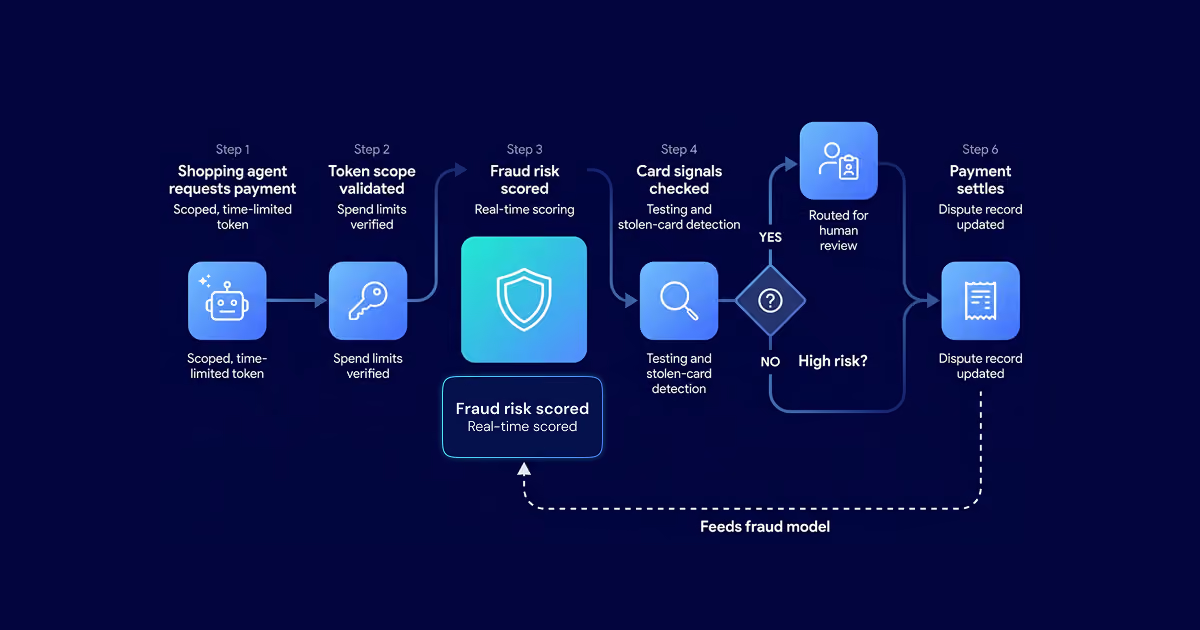
Stripe built Shared Payment Tokens specifically for this problem: scoped, time-limited credentials that let an AI agent initiate a payment without ever seeing the underlying card number.
A merchant can cap what a token is allowed to spend and how long it stays valid. The agent gets just enough access to complete the purchase it was authorized for, and nothing else.
Fraud screening runs inside that same flow rather than after it. Stripe Radar evaluates the transaction and payment method in real time, feeding risk signals back into the token layer to separate a legitimate shopping agent from a bot testing stolen cards.
Affirm and Klarna both plugged their buy now, pay later products into it in March 2026, letting a shopping agent offer installment payments at checkout the same way a human shopper would see them.
Where Fintechs Are Running This in Production
The workflow below covers fraud screening at the payment layer specifically. The sections after it cover checkout, spend management, and the two places production deployments have already run into real limits.
The workflow
Buy Now, Pay Later Inside the Agentic Checkout
Affirm and Klarna didn't build separate infrastructure for agent-driven purchases.
They extended their existing underwriting into Stripe's token flow, so an agent can complete a real-time eligibility check and offer installment terms exactly as a human shopper would see them.
The underwriting logic itself doesn't change because an agent is asking. What changes is the speed the eligibility check has to run at, since an agent won't wait through a multi-step form the way a person might.
Spend Management and Expense Agents
Corporate card platforms like Ramp and Brex apply the same agentic pattern to a company's own spend rather than a consumer's checkout: reading a receipt, matching it against a policy, and approving or flagging the expense without a person keying it in.
That workflow overlaps directly with the invoice-to-payment cycle covered in Tecla's Agentic AI for Accounts Payable guide. The mechanism is the same: match, score, route the exception, keep a human in front of anything that clears a threshold.
The Klarna Lesson: Where Full Automation Broke
In February 2024, Klarna announced its OpenAI-built assistant was doing the work of 700 customer service agents, handling 75% of chats, roughly 2.3 million conversations, across 35 languages in its first month.
The company froze hiring for over a year. Headcount dropped 22%. By May 2025, CEO Sebastian Siemiatkowski told Bloomberg the company had gone too far: "We went too far," he said, and Klarna began rehiring human agents.
Customer satisfaction declined enough on the interactions that mattered most that the company reversed course, even though the overall automation numbers still looked strong on average.
Siemiatkowski's own framing of the fix is the point: "I just think it's so critical that you are clear to your customer that there will always be a human if you want." Full automation wasn't the failure. Removing the option of a human was.
Who's Liable When the Agent Is Wrong?
The Consumer Bankers Association's January 2026 white paper flags a gap nobody has closed yet.
The Electronic Fund Transfer Act limits a consumer's liability for unauthorized transactions, but that protection assumes the consumer initiated the transaction themselves.
Handing an agent your payment credentials may count as authorizing whatever that agent does next, which could shift liability for the agent's mistakes onto the consumer instead of the bank.
Federal regulators haven't issued specific guidance, and the white paper is explicit that none is expected soon.
For a fintech shipping agentic checkout today, that ambiguity is a product decision, not just a legal footnote. Every scoped token, spend limit, and review threshold is doing work that regulation hasn't gotten around to requiring yet.
Implementation: Guardrails for Fintech Product Teams
Scope is the common thread across every production deployment above. Even the systems moving real money are built to reach only as far as a specific limit lets them.
| Layer | What it does | Fintech-specific example |
|---|---|---|
| System prompt | Sets the non-negotiables up front | "Never authorize a payment above the token's scoped limit" |
| Input filters | Block or sanitize out-of-scope requests | Treat agent-submitted transaction data as untrusted until independently verified |
| Tool-call gatekeepers | Cap what actions an agent can take | Screening and scoring allowed; raising a spend limit always needs a human |
| Output checks | Scan before the action executes | Block any settlement that doesn't carry a logged risk score |
| Human-in-the-loop | Requires approval for high-impact actions | A person reviews any transaction the fraud model can't confidently clear |
Where to Start
Fraud screening and other workflows with no consumer-facing failure mode are the lowest-risk entry point, which is exactly why Stripe built its token and risk layer before extending into BNPL and other checkout flows.
Run any new agentic workflow alongside the existing process long enough to see how it performs on the edge cases, not just the routine volume. Klarna's numbers looked strong on average and broke down specifically on the interactions that mattered most.
Keep a human option visible to the customer, not just available in theory. That distinction is the entire lesson of the Klarna reversal.
The Team Behind Production Agentic AI
Shipping this well is less about picking the right model and more about deciding, deliberately, what an agent is never allowed to do on its own.
Tecla's Agentic AI services design, build, and operate these workflows directly, the same fraud screening, checkout, and spend management systems above, running in your stack with the evals and guardrails production requires.
Or bring the expertise in-house: AI engineers who've worked on live fintech systems, past the demo stage.
Tecla runs a network of senior engineers across the US and Latin America, built over more than a decade, with a top 3% acceptance rate and first candidates in 3 to 5 business days.
FAQ


.png)
%20(1).avif)
.avif)
.avif)