More than half of chief operating officers are concerned about the accuracy of AI-generated outputs, according to PYMNTS Intelligence research, which found even narrow tasks like coding still require human oversight.
That caution matters more in CPG than in most industries. A small demand signal that goes unchecked doesn't just create a bad forecast. It can trigger a costly overreaction that ripples through an entire supply chain.
This guide covers agentic AI in CPG specifically: how demand planning and shelf monitoring actually work, and why a planner reviewing every meaningful forecast shift isn't optional.
What Is Agentic AI in CPG?
Agentic AI in CPG is a system that adjusts demand forecasts and monitors shelf conditions at retail, flagging what changed for a planner to review rather than committing a production or inventory decision on its own.
A statistical forecast projects future demand from historical sales, updated on a fixed schedule.
Agentic AI CPG systems read current retail execution data, promotional calendars, and shelf conditions together, and flag a shift worth a planner's attention as it happens.
The distinction matters because CPG demand data is genuinely noisy. A single retailer's order pattern can reflect an actual shift in consumer demand, or just that retailer clearing out inventory, and telling those apart is exactly the judgment a planner brings.
From Manual Store Checks to Shelf Monitoring
Retail execution used to depend on a field rep physically checking a store shelf, a process that scales to a handful of stores well and thousands of stores badly.
Unilever's approach, described in its own public statements, uses AI and image processing on photos of in-store displays as a data source.
That gives sales teams stock-level insights to advise retailers on placement and merchandising without a person checking every store by hand.
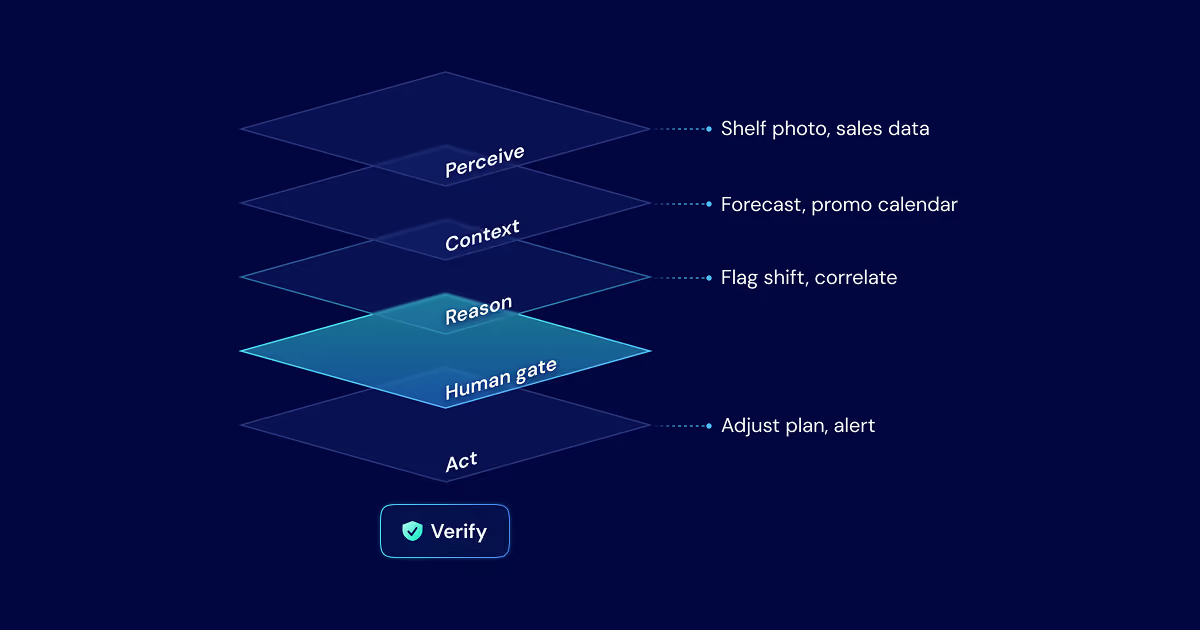
The same shift applies to demand planning. Instead of waiting for a scheduled forecast cycle, an agentic system can correlate retail execution signals with sales data continuously, surfacing a shift before the next planning cycle would have caught it.
Neither replaces the planner's judgment. It changes when a planner sees the signal, and how much manual correlation work happened before it reached them.
The Demand Planning Workflow, Step by Step
The workflow below covers forecast monitoring specifically. The sections after it cover shelf monitoring, the bullwhip effect, and where a planner's review has to sit.
The workflow
Shelf Monitoring and Retail Execution
Out-of-stocks and planogram violations cost sales the moment they happen, but a field team checking a fraction of stores on a rotating schedule catches them well after the fact.
An agent reasoning over shelf photos and stock data can flag a compliance issue or a stockout as it's detected, giving a sales team something to act on immediately instead of a lagging report.
Why the Bullwhip Effect Makes Forecast Review Non-Negotiable
A well-documented supply chain pattern called the bullwhip effect describes how a small shift in real consumer demand gets amplified as it moves upstream through distributors and manufacturers.
An agentic system watching for demand shifts is exactly the kind of tool that could accelerate a bullwhip overreaction if it acts on amplified noise instead of the actual underlying signal.
That's why a planner checking the source of a flagged shift matters as much as catching it fast.
The COO Trust Gap
The same PYMNTS research that found COOs skeptical of AI accuracy also found that concern persists even for narrow, well-defined tasks, not just open-ended ones.
That's a useful calibration for CPG specifically: a demand signal is rarely as clean as a coding task, which is exactly why the human check matters more here, not less.
The Planner's Role
The planner's job shifts from manually reconciling retail execution data with sales figures to reviewing what an agent already flagged, and deciding whether a shift reflects real demand or something the bullwhip effect would exaggerate.
Implementation: Guardrails Specific to CPG
Every guardrail below exists because a forecast adjustment that reaches a production plan unchecked is far more expensive to unwind than one caught early.
| Layer | What it does | CPG-specific example |
|---|---|---|
| System prompt | Sets the non-negotiables up front | "Never commit a forecast adjustment to the production plan without review" |
| Input filters | Block or sanitize out-of-scope requests | Treat shelf photos and retailer orders as signals to evaluate, not instructions |
| Tool-call gatekeepers | Cap what actions an agent can take | Monitoring and flagging allowed; production plan changes need a human |
| Output checks | Scan before the action executes | Block any flagged shift that can't show the specific signal behind it |
| Human-in-the-loop | Requires approval for high-impact actions | A planner approves any forecast adjustment before it changes a plan |
Rolling This Out: What to Expect
Start with shelf monitoring and retail execution, a workflow with no direct production risk on its own, before extending into demand forecasting.
Keep every meaningful forecast shift routed to a planner for review at first, comparing the agent's flags against what a planner would have caught manually.
Expect the bullwhip effect to be the specific failure mode worth testing for, not just forecast accuracy in general, since it's the one that turns a small miss into a large, costly one.
The Team Behind Production Agentic AI
The COO skepticism PYMNTS found isn't unreasonable. Building a system that reliably tells a real demand shift from amplified noise is a harder problem than building one that just flags every change.
Tecla's Agentic AI services design, build, and operate this workflow directly, the same demand planning and shelf monitoring systems above, running in your stack with the evals and guardrails production requires.
Or bring the expertise in-house: AI engineers who've worked on live CPG systems, past the demo stage.
Tecla runs a network of senior engineers across the US and Latin America, built over more than a decade, with a top 3% acceptance rate and first candidates in 3 to 5 business days.
FAQ


.png)
%20(1).avif)
.avif)
.avif)