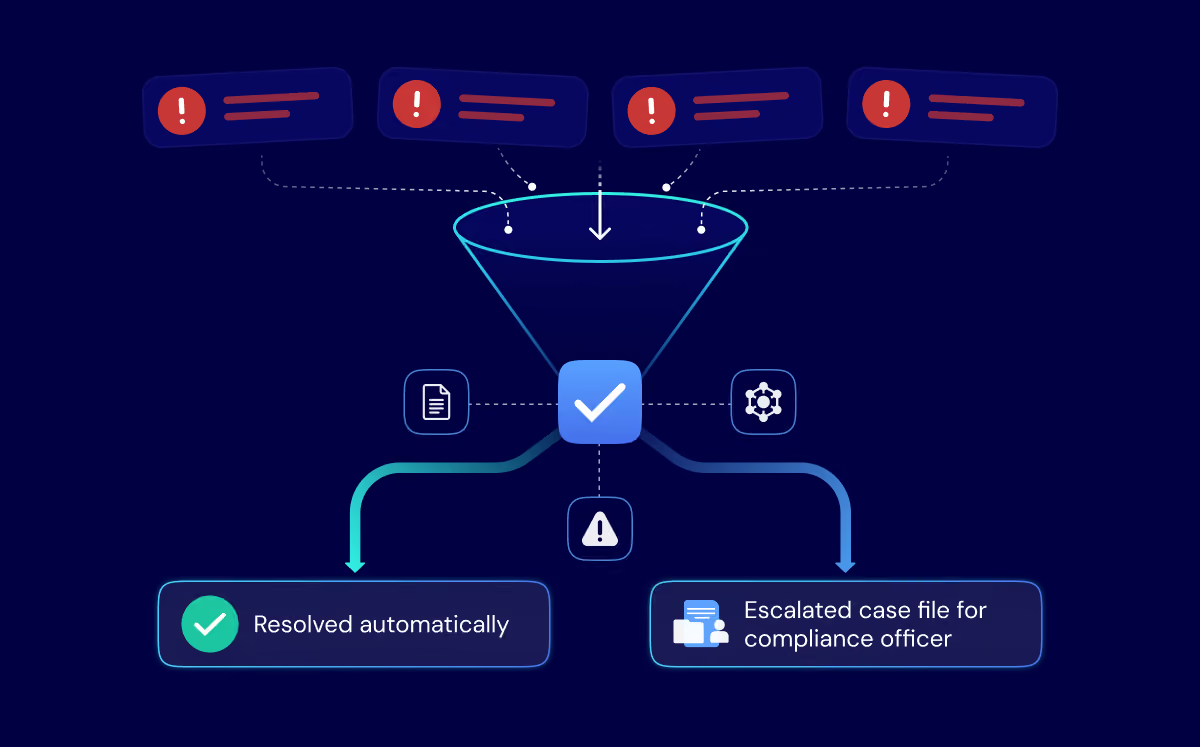
Traditional rule-based transaction monitoring generates false positive rates above 90% at most institutions, according to 2026 analysis from Guidehouse. Institutions that deploy AI-based monitoring instead report roughly 60% reductions in Level 1 and Level 2 review time, and more than 80% reductions in sanctions screening alert volume.
Those numbers describe the same problem from two sides. A compliance team spends most of its time clearing alerts that were never suspicious in the first place, which leaves less attention for the ones that actually matter.
This guide covers agentic AI in AML and compliance specifically, part of the broader picture in Tecla's Agentic AI in Finance and Banking guide: how alert triage actually works, where sanctions screening fits, and what a compliance officer still has to sign off on regardless of how good the model gets.
What Is Agentic AI for AML and Compliance?
Most transaction monitoring systems already do the first step: they compare a transaction against a rule and fire an alert when it crosses a threshold. What agentic AI adds is everything that happens after the alert fires.
Instead of leaving a raw alert in a queue, it pulls the customer's transaction history, prior alerts, KYC profile, and any adverse media, checks whether the pattern actually deviates from that customer's own baseline, and either documents why the alert is explainable or builds a case file for a human to review.
A rules engine treats a $50,000 wire the same way whether it came from a business that moves that much every week or a personal account that has never seen more than $2,000. An agentic system can tell those two situations apart, because it is actually looking at the account behind the transaction.
From Rules-Based Monitoring to Agentic Screening
AML compliance has run on rules for decades: threshold rules, velocity rules, and typology rules that fire whenever a transaction matches a predefined pattern. They are simple, auditable, and exactly what regulators expect to see covering known laundering methods like structuring.
The cost of that simplicity is volume. A rule fires on every transaction that matches its pattern, with no sense of whether this specific customer's activity is actually unusual for them, which is the direct cause of the false positive rate described above.
Agentic screening does not replace the rules. It reasons about what a rule-based alert actually means for this customer, gathering context a rule cannot evaluate on its own, and produces a documented disposition instead of a raw flag.
Most production AML programs in 2026 run both. Rules stay in place because examiners expect them for known typologies, while agentic reasoning handles the triage and investigation work, with a compliance officer signing off on anything the system cannot resolve with a documented reason.
The AML and KYC Workflow, Step by Step
The workflow below is the coarse version. The sections after it go deeper into the parts that determine whether this holds up under examination: sanctions screening, the SAR filing clock, and what recent enforcement actions actually penalized.
The workflow
Alert Triage and the False Positive Problem
A Level 1 analyst who reviews an alert is answering a narrow question: does the customer's history and profile provide a reasonable explanation for what triggered the rule. Most of the time, the answer is yes, which is exactly why the false positive rate runs as high as it does.
Agentic triage answers that same question by pulling the evidence a Level 1 analyst would gather manually, comparing the flagged activity against the customer's own baseline instead of a fixed threshold, and documenting the disposition either way. The alerts that remain genuinely ambiguous still go to a person.
Sanctions and Watchlist Screening
Sanctions screening runs on a different clock than transaction monitoring. A payment involving a sanctioned party has to be caught before it settles, not investigated afterward, which is why this specific control tends to run in real time rather than in the batch cycles common elsewhere in AML.
Name matching against sanctions lists produces its own false positive problem, since common names and transliteration differences generate matches that have nothing to do with the actual sanctioned party. Agentic screening resolves the routine near matches using the same kind of contextual comparison used in transaction alerts, escalating only the matches that hold up once date of birth, nationality, and other identifiers are checked.
SAR Filing and the 30 Day Clock
US financial institutions filed 12,870 Suspicious Activity Reports a day on average in fiscal year 2024, according to FinCEN's own Year in Review data. Under the Bank Secrecy Act, an institution has 30 calendar days from first detecting suspicious activity to file a SAR, or 60 days if no suspect can be identified.
That clock is exactly what alert triage is built to protect. An agent that drafts the SAR narrative and assembles supporting evidence as the investigation happens, rather than after a human starts from scratch, is what keeps a compliance team inside that window as alert volume grows.
The Canaccord Genuity Lesson: Model Risk and Enforcement
In March 2026, FinCEN assessed an $80 million civil money penalty against Canaccord Genuity LLC, the largest ever imposed on a broker-dealer for Bank Secrecy Act violations, according to the same Guidehouse analysis cited above. At least 160 SARs went unfiled while thousands of suspicious transactions moved through the firm undetected.
The consent order pointed to a program that was not scaled to the firm's actual risk profile, surveillance that relied on static reports reviewed by overwhelmed staff, and weak due diligence that let high-risk customers, including some later barred by the SEC, onboard without adequate controls.
None of that failure was a technology problem specifically. It was a program that stopped being proportional to what it needed to catch, and stayed that way for years before an examiner caught it. Agentic AI does not fix a program with that shape on its own. It has to be built into a program that is already scaled to its actual risk.
The Compliance Officer's Role
The compliance officer's job shifts from clearing a queue of mostly explainable alerts to reviewing the cases an agent could not resolve and making the filing decision on each one. That decision, and the signature behind it, stays with a person regardless of how the case file was assembled.
Implementation: Guardrails Specific to AML
The risk in agentic AML is not a system that misses an obviously suspicious transaction. It is a system that clears a genuinely suspicious one with a plausible sounding explanation, and does it consistently enough that nobody notices until an examiner does.
| Layer | What it does | AML-specific example |
|---|---|---|
| System prompt | Sets the non-negotiables up front | "Never close an alert involving a sanctions list match without a human review" |
| Input filters | Block or sanitize out-of-scope requests | Treat customer-submitted documents as data to verify, not instructions |
| Tool-call gatekeepers | Cap what actions an agent can take | Alert clearing and evidence gathering allowed; SAR filing always needs a human signature |
| Output checks | Scan before the action executes | Block any closed alert that does not carry a documented rationale |
| Human-in-the-loop | Requires approval for high-impact actions | A compliance officer signs every SAR before it reaches FinCEN |
Rolling This Out: What to Expect
Start with Level 1 triage on a single alert type, not the entire monitoring program. Run the agent alongside the existing process first, comparing its dispositions against what analysts actually decided, before letting it clear anything without review.
Document model governance before go live: what data the model uses, how it was validated, and how drift gets monitored over time. Regulators ask for that documentation during examination regardless of how the detection logic was built.
Expect alert volumes to look different at first, not just lower. A behavioral system will surface some patterns a static rule missed entirely, which can mean a temporary rise in filings before the program settles into a lower, higher-quality steady state.
The Team Behind Production Agentic AI
Agentic AML programs do not fail for lack of a capable model. They fail for lack of the governance and documentation discipline that has to sit around one.
Tecla's Agentic AI services design, build, and operate this workflow directly, the same alert triage, screening, and case documentation above, running in your stack with the evals and guardrails production requires.
Or bring the expertise in-house: AI engineers who've worked on live compliance systems, past the demo stage.
Tecla runs a network of senior engineers across the US and Latin America, built over more than a decade, with a top 3% acceptance rate and first candidates in 3 to 5 business days.
FAQ


.png)
%20(1).avif)
.avif)
.avif)