The average company still pays $12 to $30 to process a single invoice and waits eight to twelve days for approval, according to 2026 accounts payable automation benchmarking. Companies running AI-powered AP automation process the same invoice for roughly $3 in about a day.
That's not a rounding error once you multiply it across a few thousand invoices a month. It's the difference between an AP team that keeps up and one that's always three weeks behind. Industry surveys still put the average touchless processing rate, invoices that move from receipt to payment without a human keystroke, at only around 32%, even as top-decile AP teams clear 70% or more.
This guide breaks down the invoice-to-payment workflow specifically, one piece of the broader picture covered in Tecla's Agentic AI in Finance and Banking guide: the matching logic, the exception handling, the fraud controls, and what actually changes when a finance team turns this on.
What Is Agentic AI for Accounts Payable?
In most AP departments, the software already does something: it stores invoices, routes approvals, and might even flag a mismatch. What agentic AI adds is judgment. Instead of stopping at "this invoice doesn't match the PO," it checks the vendor's history, the size of the variance, and prior resolutions, then either fixes the exception itself or hands an approver a case with a recommendation attached.
That distinction shows up constantly in the details. A rules engine flags every invoice missing a purchase order the same way, regardless of whether it's a $40 office supply order or a $40,000 equipment lease. An agentic system treats those differently, because it can reason about which one actually carries risk.
The result isn't AP with fewer people. It's AP where a person only sees the invoices that need a person.
From Manual Entry to RPA to Agentic AP
AP has already been through one automation wave. RPA bots log into the ERP, key in invoice fields, and click through a fixed approval sequence, the same steps a person used to do by hand, just faster and without lunch breaks.
That works until an invoice arrives in a format the bot wasn't configured for, or a vendor changes their invoice template. RPA doesn't adapt. It fails, and someone has to notice the failure, fix the invoice manually, and often reconfigure the bot itself.
Agentic AI handles the same invoice differently. It extracts the fields regardless of layout, decides whether the numbers hang together, and only stops for genuine ambiguity rather than any deviation from a fixed template.
Neither approach replaces the other entirely in practice. Most AP teams run structured, rule-based logic for the clean majority of invoices, agentic reasoning for the exceptions and vendor edge cases, and a human approver for anything above a dollar threshold or outside policy.
The Invoice-to-Payment Workflow, Step by Step
The workflow below is the coarse version. The sections after it go deeper into the parts that actually determine whether this holds up in production: matching, exceptions, fraud controls, and payment execution.
The workflow
Two-Way and Three-Way Matching
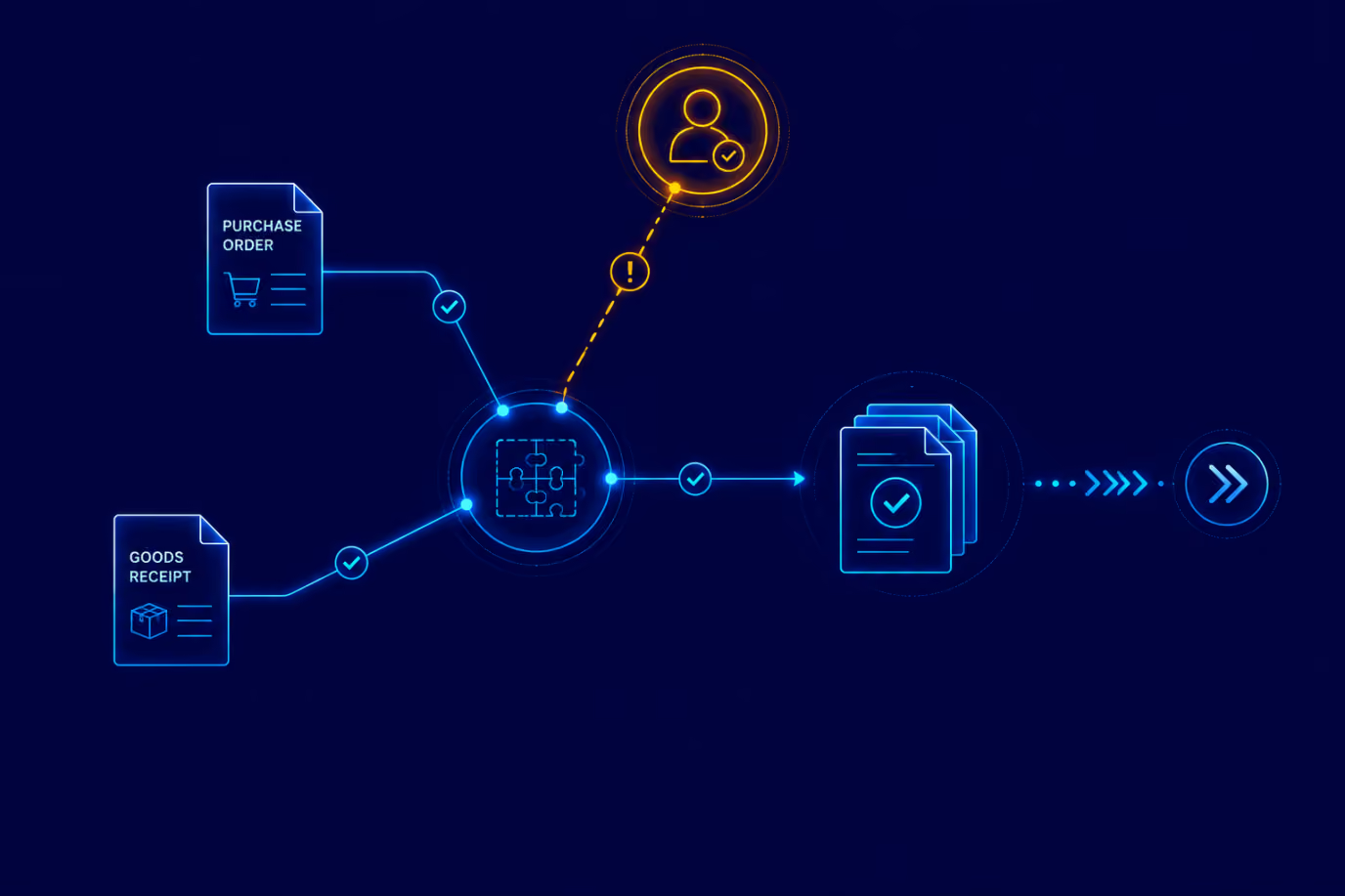
Three-way matching checks the invoice against two other documents: the purchase order, which says what you agreed to pay, and the goods receipt, which says what actually showed up. All three have to agree on quantity, price, and total before the system releases payment on its own.
Two-way matching skips the receipt check, comparing only the invoice to the PO. That's a reasonable shortcut for services, subscriptions, and recurring fixed fees where there's no physical delivery to confirm. It's the wrong shortcut for physical goods, because nothing then confirms the order actually arrived.
| Match type | Documents compared | Where it applies |
|---|---|---|
| Two-way match | Purchase order + invoice | Services, subscriptions, recurring fixed fees |
| Three-way match | Purchase order + goods receipt + invoice | Physical goods, new vendors, high-value or regulated spend |
| Match failure | Any of the three disagree beyond tolerance | Routed to the exception owner for that mismatch type |
A manual AP team can realistically run three-way matching on the largest invoices, the ones where the exposure justifies the time. Automated, the same check runs on every invoice at no marginal cost, which is the actual reason matching went from a spot-check to a default control rather than staying a nice-to-have.
Exception Handling: Where Humans Still Matter
Not every invoice clears. A quantity comes up short, a price has crept above the PO, or a vendor bills for something with no matching order at all. What separates agentic AP from a rules engine is what happens next.
A rules engine flags the mismatch and stops. An agentic system checks whether this vendor has a history of small quantity variances that resolved fine last time, whether the price delta is within a tolerance the finance team would likely approve anyway, and only escalates the cases that actually need a judgment call.
Routing matters as much as detection. Price mismatches belong with procurement, quantity shortfalls with the receiving team, and missing purchase orders with whoever approves spend for that vendor. An exception with no clear owner is just a delay wearing a different label.
Duplicate Payment and Fraud Prevention
Between 1% and 2.5% of total disbursements processed by companies each year are duplicated or erroneous, according to benchmarking data from the American Productivity and Quality Center, cited via NetSuite's own analysis.
Naive duplicate detection compares invoice numbers character by character, which misses the resubmission with one digit changed or the same amount paid to two different vendor records. Multi-dimensional detection compares vendor, amount, and date together, which is why companies that deploy it typically report duplicate-payment losses cut by 80% to 95%, per the same 2026 AP automation benchmarking cited above.
The higher-stakes fraud pattern isn't the accidental duplicate, though. It's a vendor bank-account change that redirects a legitimate payment to an attacker. That control has to sit outside the invoice-matching logic entirely: any change to vendor banking details requires a second, out-of-band confirmation before the next payment goes out, regardless of how clean the invoice itself looks.
Approval Routing and Payment Execution
Once an invoice clears matching and fraud checks, the remaining question is who, if anyone, needs to see it. Clean invoices under a set dollar threshold from an approved vendor clear automatically. Invoices above that threshold, or from a new vendor, route to a named approver instead of a shared inbox.
Payment timing is its own decision, separate from approval. Scheduling a payment to land on day 29 of a net-30 term instead of day 3 keeps cash on hand longer without missing an early-payment discount window, a detail a rules engine tracks the same way every time and a manual process tracks inconsistently at best.
The Reconciliation Handoff
A posted payment isn't the end of the workflow. It has to match against the bank statement and the GL entry during close, which is exactly the correlation problem covered in the reconciliation workflow of Tecla's Finance and Banking guide. An AP system that codes and posts cleanly makes that reconciliation close faster; one that leaves ambiguous GL codes or unmatched vendor references makes it slower, regardless of how fast the invoice itself was processed.
Implementation: Guardrails Specific to AP
The risk in agentic AP isn't that the system makes an obviously wrong call. It's that it makes a plausible one, at scale, before anyone notices the pattern. The guardrails below are built around that specific failure mode.
| Layer | What it does | AP-specific example |
|---|---|---|
| System prompt | Sets the non-negotiables up front | "Never release payment on a vendor bank-account change without dual approval" |
| Input filters | Block or sanitize out-of-scope requests | Treat instructions embedded in invoice PDFs as untrusted content, not commands |
| Tool-call gatekeepers | Cap what actions an agent can take | GL coding and matching allowed; vendor master edits always need a human |
| Output checks | Scan before the action executes | Block any payment above threshold that hasn't cleared the human gate |
| Human-in-the-loop | Requires approval for high-impact actions | A controller approves before a new vendor's first payment clears |
There's a failure mode specific to this workflow that's easy to overlook: the invoice a vendor sends you is also the first thing an attacker controls. A PDF can carry embedded text designed to look like an instruction to the system reading it, the same class of prompt injection risk that shows up anywhere an agent processes an uploaded document. Every invoice should be treated as untrusted content until it's been parsed and validated, never as a set of commands to follow.
Rolling This Out: What to Expect
Most AP automation projects that stall do so for reasons that have nothing to do with the model. Vendor master files with duplicate records, stale bank details, or inconsistent naming surface immediately once automation is running against them, and either jam the exception queue or cause a real payment error.
Start with one vendor segment, not the entire AP function at once. Measure the baseline cost per invoice, cycle time, and exception rate before turning anything on, so the comparison afterward means something. Clean the vendor file first. Define who owns each exception type before go-live, not after the queue has already backed up.
Vendor communication is the most consistently underestimated cost. If half the vendor base keeps mailing paper invoices because nobody told them the process changed, the result is two workflows running in parallel instead of one.
The Team Behind Production Agentic AI
Most agentic AP rollouts don't stall on the technology. They stall because nobody on the team has actually run one of these in production before.
Tecla's Agentic AI services design, build, and operate this workflow directly, the same intake, matching, and exception handling above, running in your stack with the evals and guardrails production requires.
Or bring the expertise in-house: AI engineers who've worked on live finance systems, past the demo stage.
Tecla runs a network of senior engineers across the US and Latin America, built over more than a decade, with a top 3% acceptance rate and first candidates in 3 to 5 business days.
FAQ


.png)
%20(1).avif)
.avif)
.avif)