Turing sells scale: a pool of millions, matched by algorithm, deployed as contractors through a third party. For a lot of teams that is enough. For others, the questions it leaves open are the ones that matter most once the engineer is actually on the team.
Three of those questions recur. How much of the bill is margin, when no rate card is published. Who employs the developer, when the contract runs through a separate payroll layer. And how much of your day they cover, when the default is a few hours, not a full one.
The ten below are compared on how they vet, what they charge and how that charge is structured, who legally employs the developer, the term that matters most for that model, and what recourse exists when a match fails.
Figures come from published materials where they exist and independent comparisons where they do not.
Top 10 Turing Alternatives for Hiring Developers
#1 Tecla
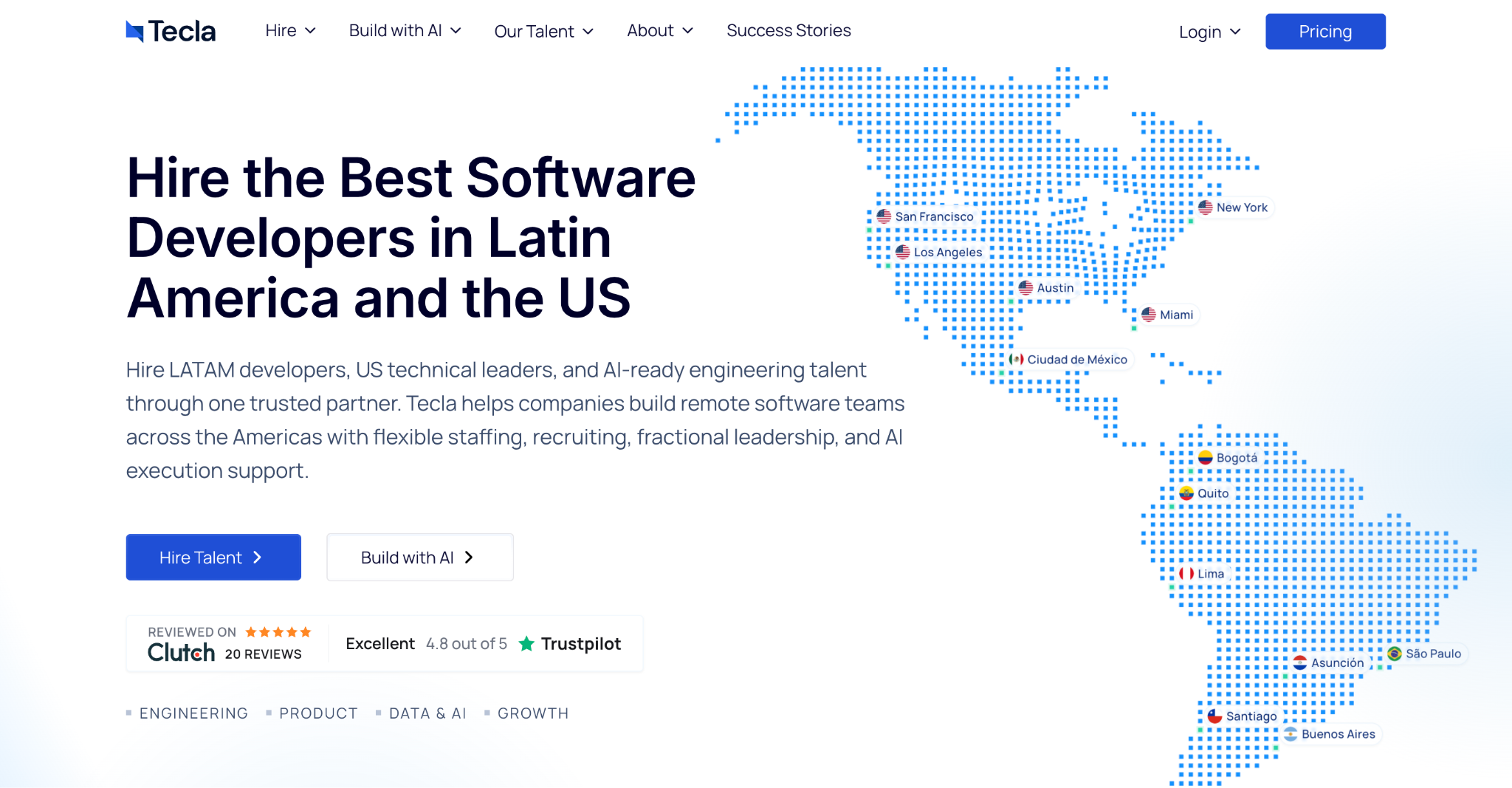
Tecla has been placing remote software engineers with US companies since 2013, from a network of 50,000+ vetted professionals across the US and 18+ Latin American countries. Every candidate passes an AI-fluency screen alongside a live technical assessment.
Screening that arrives finished is the first difference from an algorithmic match: candidates reach an interview within 5 days of the intake call, already through a live technical assessment and an AI-fluency screen.
Employment handled by default puts the engineer under Tecla's EOR in their own country, so classification, payroll, and local labour law never route through a separate provider or land on the client.
The whole network sits in your working day, across the US and Latin America, so overlap is a full business day rather than the few hours a global pool defaults to.
A 90-day replacement guarantee sits in the engagement agreement, confirmed before signing. It is rarely called on: 97% of placements succeed and 96% of the talent stays.
Our verdict: Turing optimises for the size of the bench. More than a decade of placing remote engineers went into the parts that come after the match, and the same relationship covers direct-hire, staff augmentation, fractional leadership, or a scoped build.
#2 Toptal
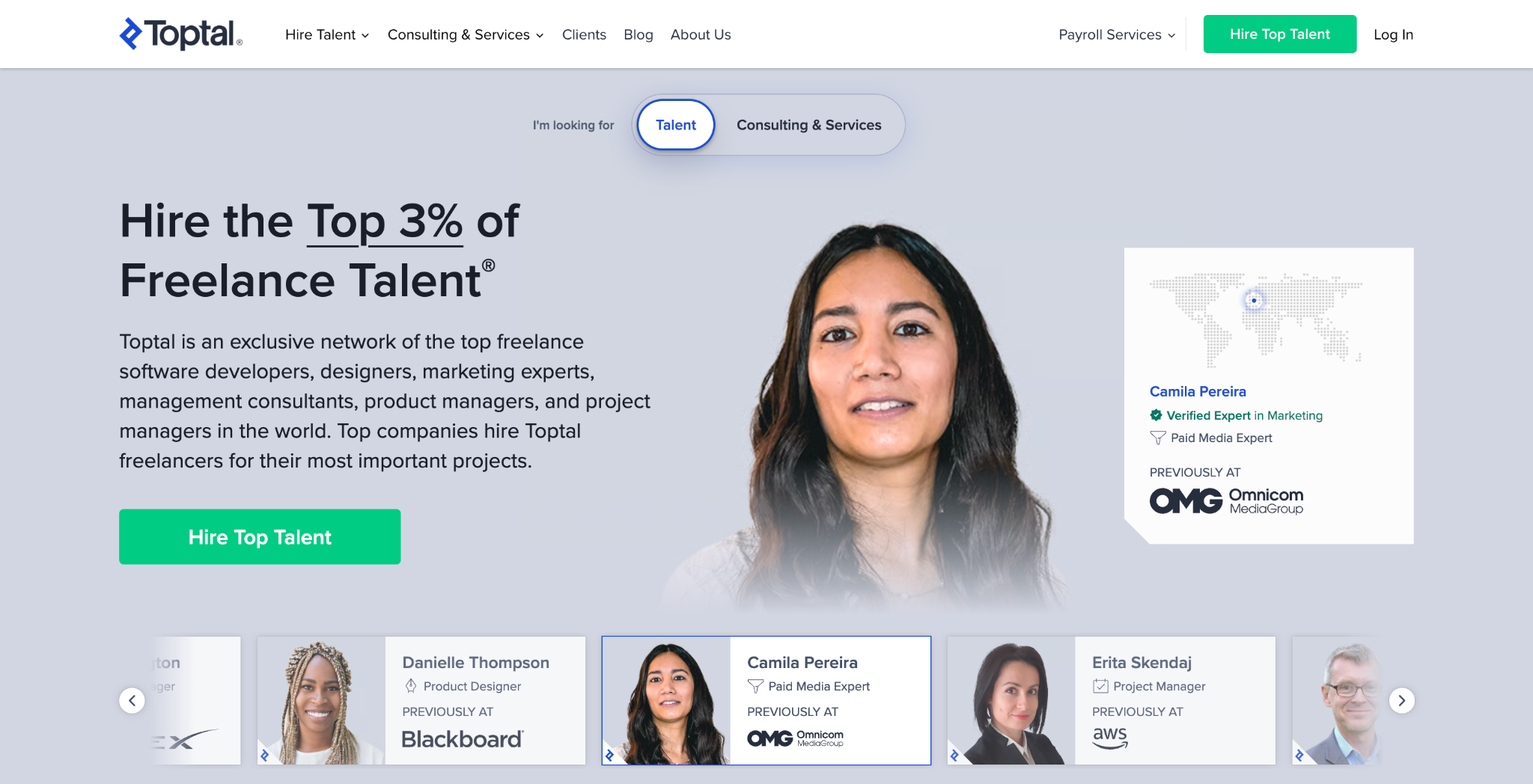
Toptal is an invite-only vetted network accepting fewer than 3% of applicants, charging $60 to $200+ an hour alongside a $500 deposit and a $79 monthly subscription.
Rigorous vetting and no bidding is the upgrade over an algorithmic pool: multi-stage screening, direct matching, and a 24-hour shortlist.
Three charges instead of one is the structure. The hourly rate carries an undisclosed margin, which independent analyses put at 30% to 50% above the developer's take-home, on top of the deposit and the monthly fee.
Our verdict: for a well-funded team the rigour justifies the rate, and the vetting is stronger than Turing's automated screen. Modelling the total stays hard, because the margin is never broken out.
#3 Arc.dev
Arc.dev is an AI-matched marketplace advertising the top 2% of remote developers from a pool of 450,000+, publishing contract rates from $15 to $110+ an hour with a 20% fee on full-time conversions.
Published rates and instant matching are the draw, and the direct answer to Turing's undisclosed margin: contract rates shown from $15 to $110+ an hour and a $300 refundable deposit against the first invoice.
AI screening at the senior end is the shared weakness with Turing, with independent reviews describing shortlists that miss nuance on senior evaluations and turn generic on narrow stacks.
Our verdict: for mid-level work this is faster and cheaper than Turing, and the rate is visible. Senior hiring is where the automation hands the evaluation back.
#4 Gun.io
Gun.io screens for a minimum of five years of experience, handles contracts, payroll billing, and tax compliance on the talent side, and shows client rates in full before an engagement starts.
Rates shown in full is the direct contrast with Turing: the client sees the developer's full quoted rate with no platform fee layered on top, no deposit, and no subscription.
A premium floor comes with it, since the network is built around senior engineers and longer contracts, with full-time placements at 20% of first-year salary.
Our verdict: the rate transparency is the product, and it fixes exactly what Turing's model obscures. Budget is the gate, since this sits at the top of the market.
#5 Lemon.io

Lemon.io screens developers through four human stages at roughly a 1.2% acceptance rate, rejecting anyone with under five years in the required stack, and gives clients a market-rate calculator by seniority.
Human screening instead of an algorithm is the direct contrast with Turing: four vetting stages run by senior engineers, no AI screen, matches inside 24 to 48 hours, Trustpilot at 4.8.
A 160-hour minimum is the constraint, a full month at full-time pace before any work begins.
Our verdict: on vetting rigor this is a clear step up from an automated match. The commitment floor is what decides whether it fits.
#6 Revelo
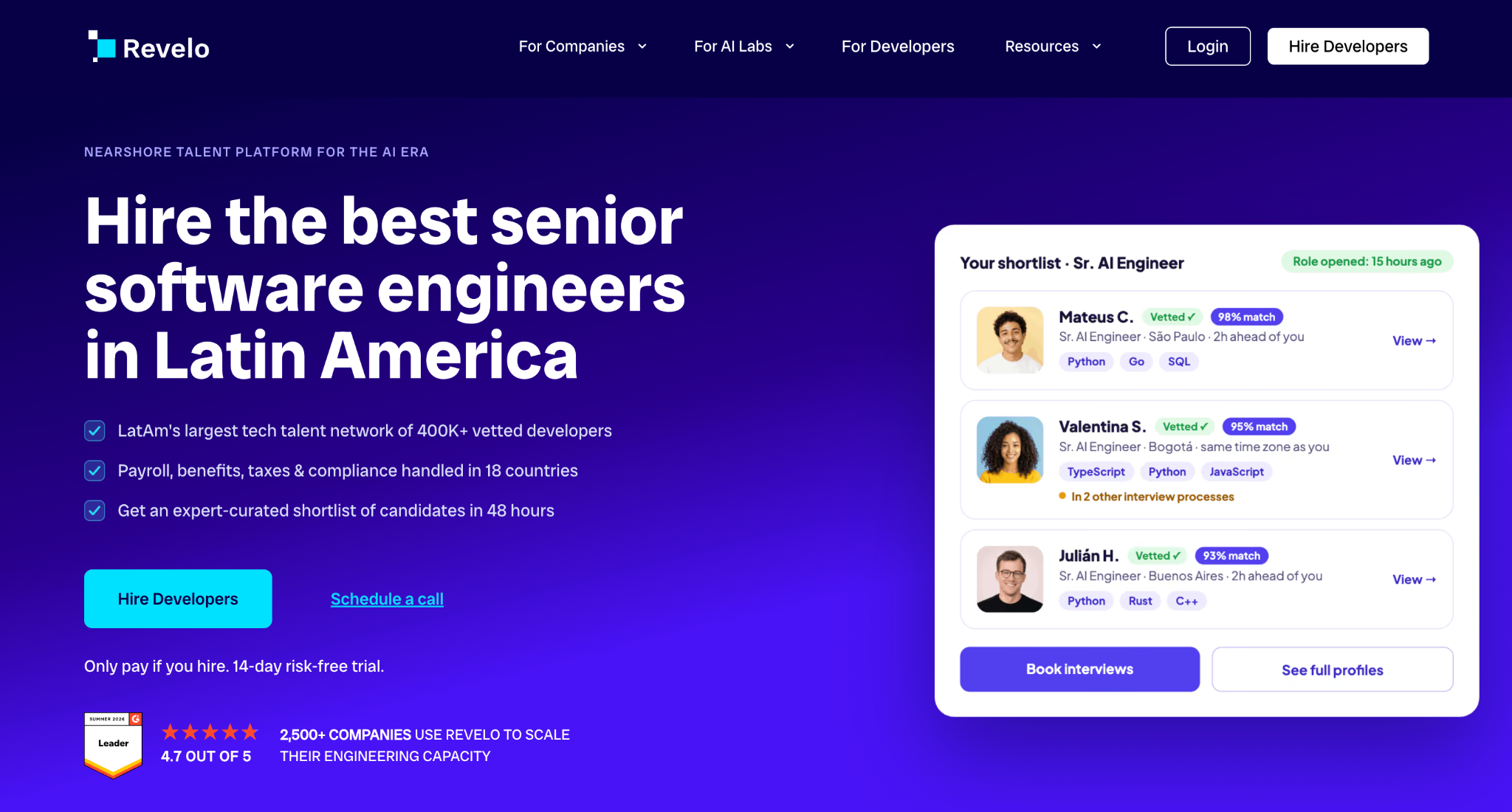
Revelo is the largest Latin American developer marketplace, advertising 400,000+ vetted engineers across the region with an Employer of Record underneath the placement.
Employment handled and US-hours overlap are the two things Turing does not do by default: Revelo runs an EOR and recruits in the client's time zone, with nothing to pay until a hire is made. The rate itself is quoted per role on a sales call, not published.
A placement relationship is where it ends, so a later need for interim technical leadership starts a new vendor search.
Our verdict: for a long-term LATAM hire with compliance included this is a strong option with a risk-free entry. Engagement range is the boundary to check.
#7 Andela
Andela is a global talent marketplace with 150,000+ vetted engineers across 135+ countries, publishing a flat monthly range of $6,000 to $14,000 per developer on a 12-month minimum.
A published monthly range and deep bench are the strengths: $6,000 to $14,000 per developer across 135+ countries, more transparent on price than Turing while comparable on scale.
A 12-month minimum and a $50,000 conversion fee are the structural cost, charged if you later hire a placed engineer directly, and the developer remains a contractor with classification on your side.
Our verdict: at enterprise scale the vetting and reach hold up. The lock-in and conversion fee are the terms to take to procurement before signing.
#8 BairesDev
BairesDev is one of the largest nearshore providers in Latin America, employing its own engineers across seven LATAM markets and billing roughly $50 to $99 an hour, quoted per engagement.
Own employees and timezone overlap are the advantages over Turing's contractor pool: BairesDev employs its engineers across seven LATAM markets, giving 0 to 3 hours of US overlap, with bill rates of $50 to $99 an hour on Clutch's verified client reviews.
A sales process before any price is the tradeoff, with no public rate card and a replacement guarantee that is not disclosed publicly.
Our verdict: for nearshore delivery at scale with the provider as employer, the model is sound. The opacity and the premium are what to weigh.
#9 Upwork
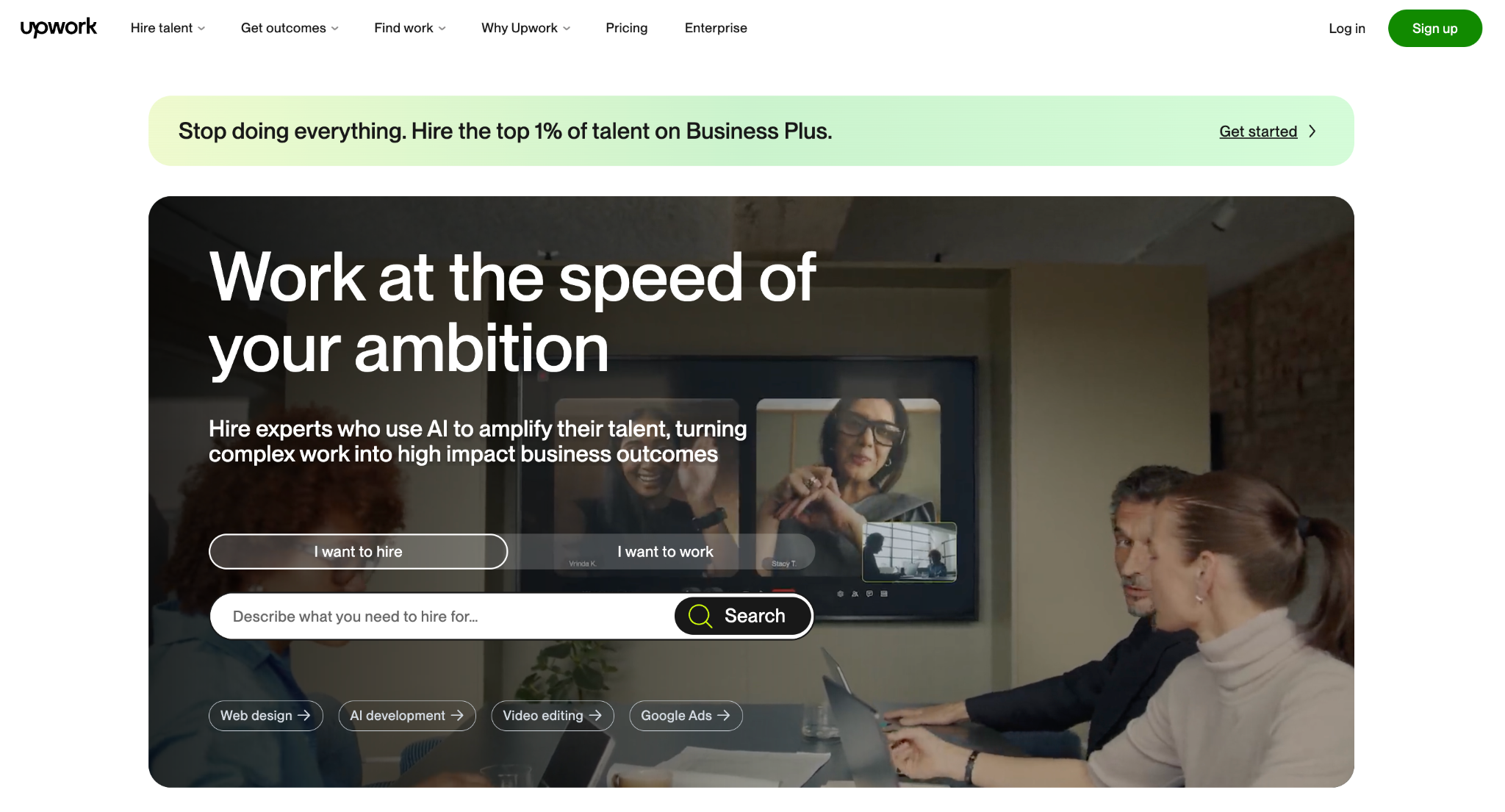
Upwork is the largest open marketplace, where clients post work and run their own screening while the platform supplies contracts, escrow, and payments.
No margin folded into the rate is the structural advantage over Turing: the rate you agree is the rate, with client marketplace fees up to 10% on Business Plus and direct contracts at a $49 monthly charge.
No screening layer is the same fact from the other side. Every filter is yours to build, and classification stays entirely with you.
Our verdict: on price this wins, and the rate is transparent. What it does not do is the vetting a curated network exists to do.
#10 Fiverr Pro

Fiverr Pro is the vetted tier above Fiverr's open marketplace, organising work as fixed-price deliverables with a 5.5% buyer service fee at checkout.
Fixed-price deliverables suit a well-specified build, and the Pro tier adds a screening layer the open marketplace lacks, with a 5.5% buyer fee at checkout.
Poorly suited to ongoing work is the boundary, since each new scope is a fresh purchase rather than a continuing engagement.
Our verdict: for a bounded artifact with a written spec this is efficient. Sustained product engineering is the wrong shape for it, and the developer is never employed by the platform.
On methodology: figures reflect each platform's published materials where they exist, and independent analyses and public reviews where they do not. Rates and terms change, so confirm current pricing with each platform before deciding.
What This Comes Down To
Turing's pitch is the size of the pool and the speed of the match. Nothing on this list beats it on raw scale, and for a team that can screen its own shortlist and hold classification itself, that may be all it needs.
The alternatives split by what they fix. Arc.dev and Gun.io make the rate visible. Toptal and Lemon.io replace the algorithm with human vetting. Revelo, Andela, and BairesDev bring the developer closer on region or employment. Upwork and Fiverr Pro go cheaper and more hands-off.
Tecla is the one that closes all three gaps Turing leaves open at once: the screening finished before the interview, the engineer employed under EOR from the first day, and a full working-day overlap by design.
Frequently Asked Questions





%20(1).avif)