
AI skills have become the hardest capability on the market to hire for. In ManpowerGroup's 2026 Talent Shortage Survey of 39,000 employers across 41 countries, they rank ahead of every traditional engineering and IT skill, with 72% unable to find the talent they need.
That scarcity produced two very different kinds of vendor, and buyers routinely confuse them. Software screens the applicants you already have. A recruiting agency finds and vets the ones who never applied. This list covers the second kind.
Each one is compared on how it vets for AI capability, how it prices, which engagement models it runs, and what recourse exists when a hire misses.
Figures come from each firm's published materials where they exist, and from independent reviews where they do not.
Top 11 Recruiting Agencies for AI Talent
#1 Tecla
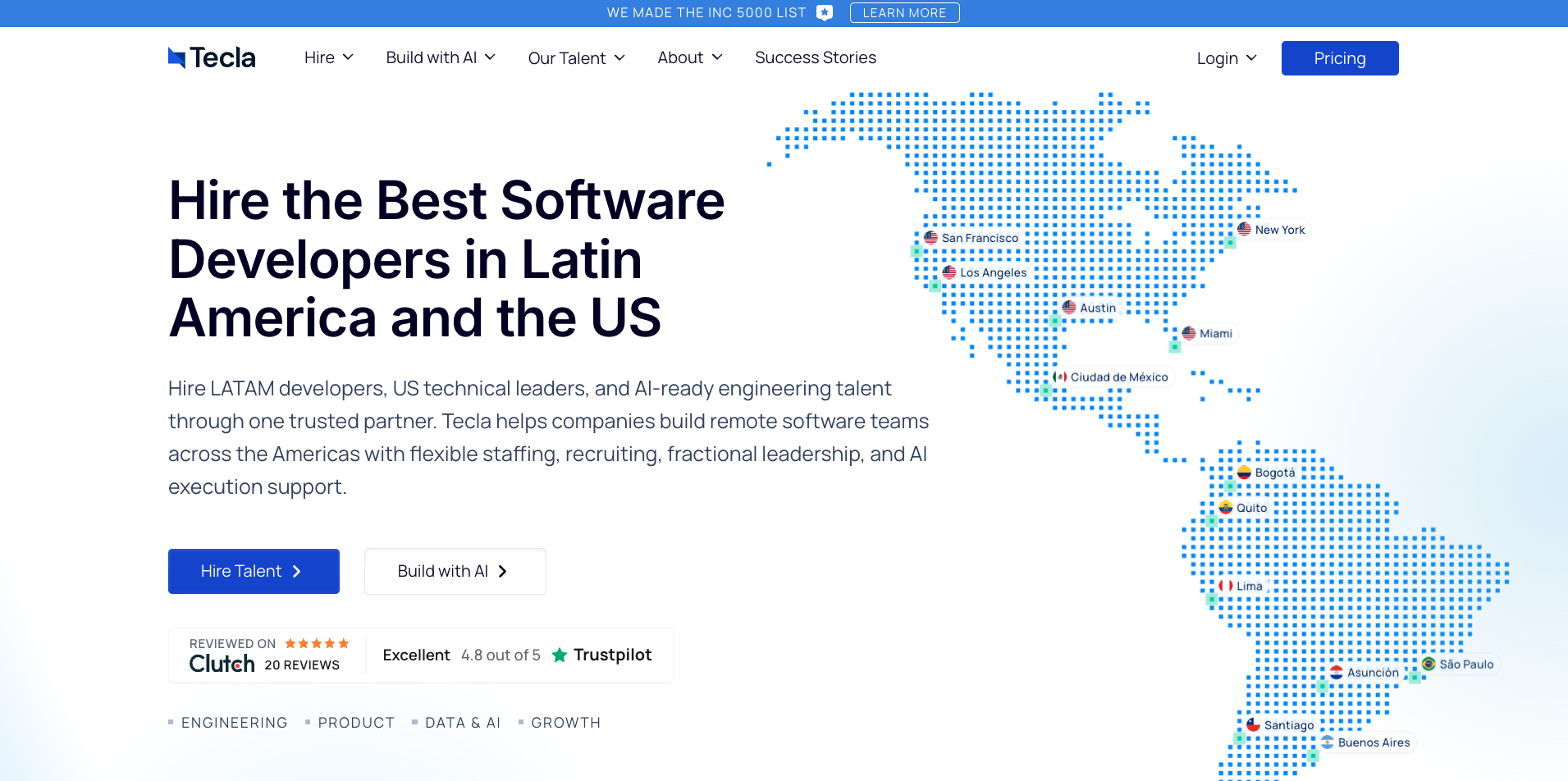
Tecla is an AI-first technical talent partner across the US and Latin America, founded in 2013. Every candidate is screened for AI fluency alongside the technical assessment, drawn from a network of 50,000+ professionals in 18+ Latin American countries.
AI-fluency screening runs on every candidate at every tier, alongside a live technical assessment. It tests how an engineer reasons with these tools in hand, on architecture calls and on what to automate.
Employment handled by default means the engineer is properly employed in their own country under Tecla's EOR, so classification and payroll never land on the client. Candidates reach an interview within 5 days.
AI leadership and delivery sit in the same relationship. Tecla staffs a fractional Chief AI Officer when the function needs direction before a full-time hire, and scopes agentic and generative AI builds white-label on the client's own infrastructure.
A 90-day replacement guarantee sits in the engagement agreement, confirmed before signing. It is rarely called on: 97% of placements succeed and 96% of the talent stays.
Our verdict: most firms here either source AI engineers or build AI systems. Tecla does both from one network, which matters when the honest answer to a brief is a team, a leader, and a system, not a single seat.
#2 Turing
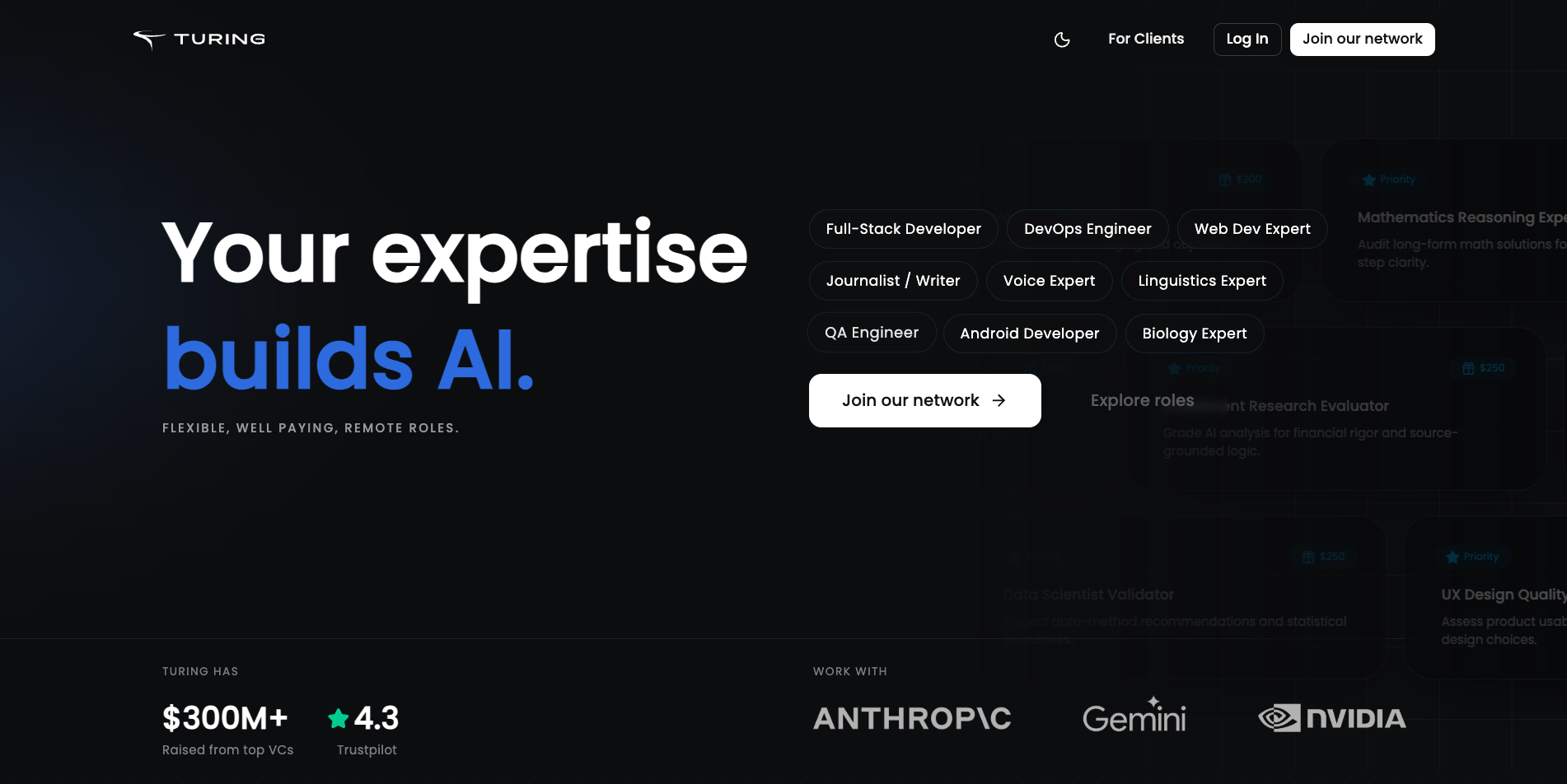
Turing is an AI-matched developer marketplace with a pool of 3M+ across 150+ countries, paying engineers as independent contractors through Deel.
Matching speed at scale is the draw, with candidates surfacing in 3 to 5 days from a pool no specialist firm can match on size.
A large embedded margin is the cost. Turing publishes no rate card, and independent reviews estimate 50% to 55% of each invoice is retained as margin, a figure Turing has not confirmed.
Our verdict: the pool and the matching are real. What a five-figure monthly bill buys is harder to judge when the margin is unverifiable and the engineer may hold other clients.
#3 Paraform
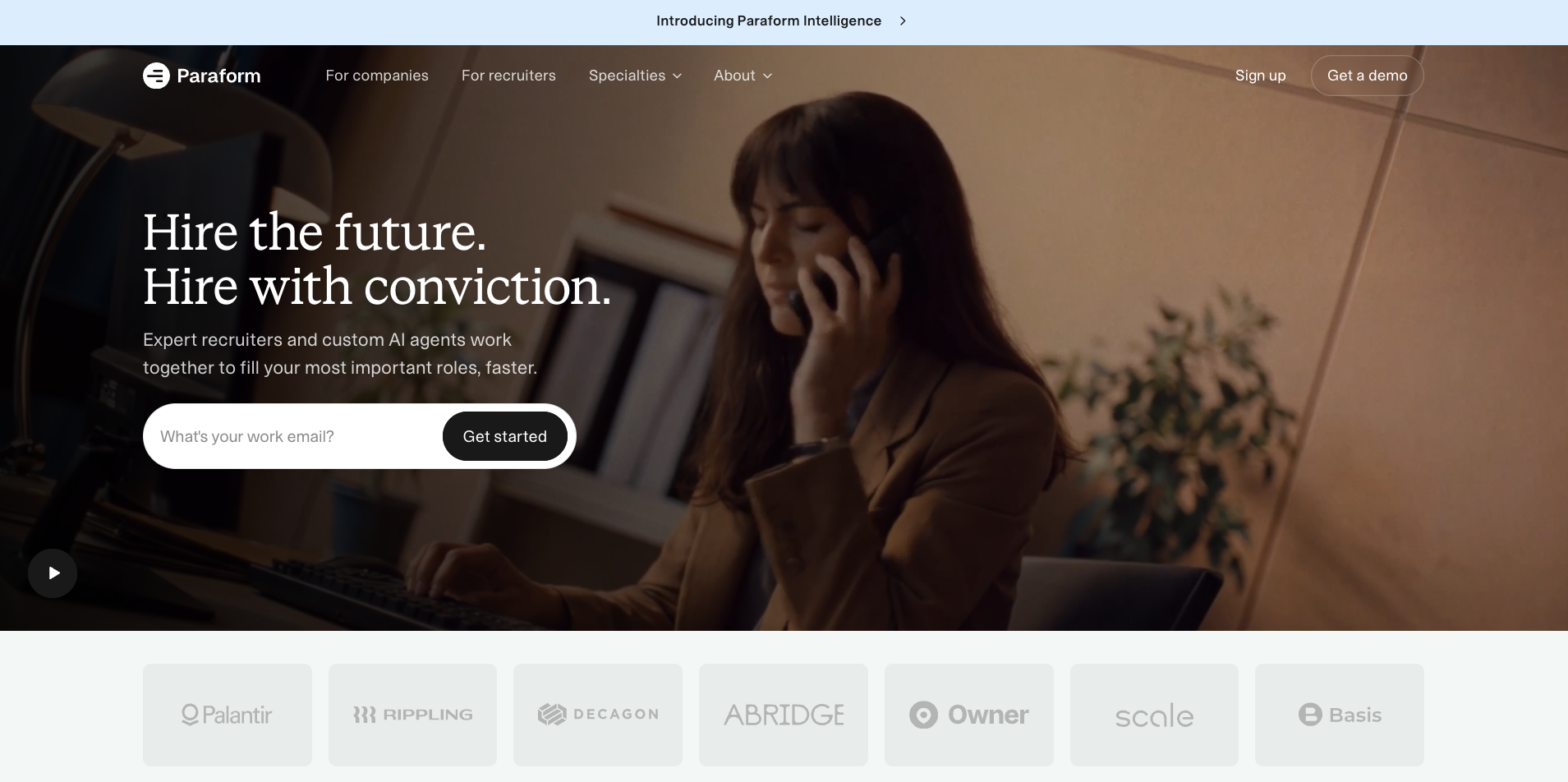
Paraform matches each role with 3 to 5 specialised external recruiters who compete to deliver candidates, working on contingency at 20% to 25% of first-year salary.
Specialist recruiters on contingency is a genuinely different mechanism: several recruiters work the same brief, and interview-ready candidates arrive in roughly 10 days with a 90-day guarantee attached.
Permanent hiring only is the boundary. There is no employment layer and no contract option, so a role that should start as capacity rather than headcount does not fit the model.
Our verdict: for one hard permanent hire this is a sharp instrument, and the guarantee is among the clearest published in this category. Anything that needs to start as capacity sits outside it.
#4 Dover
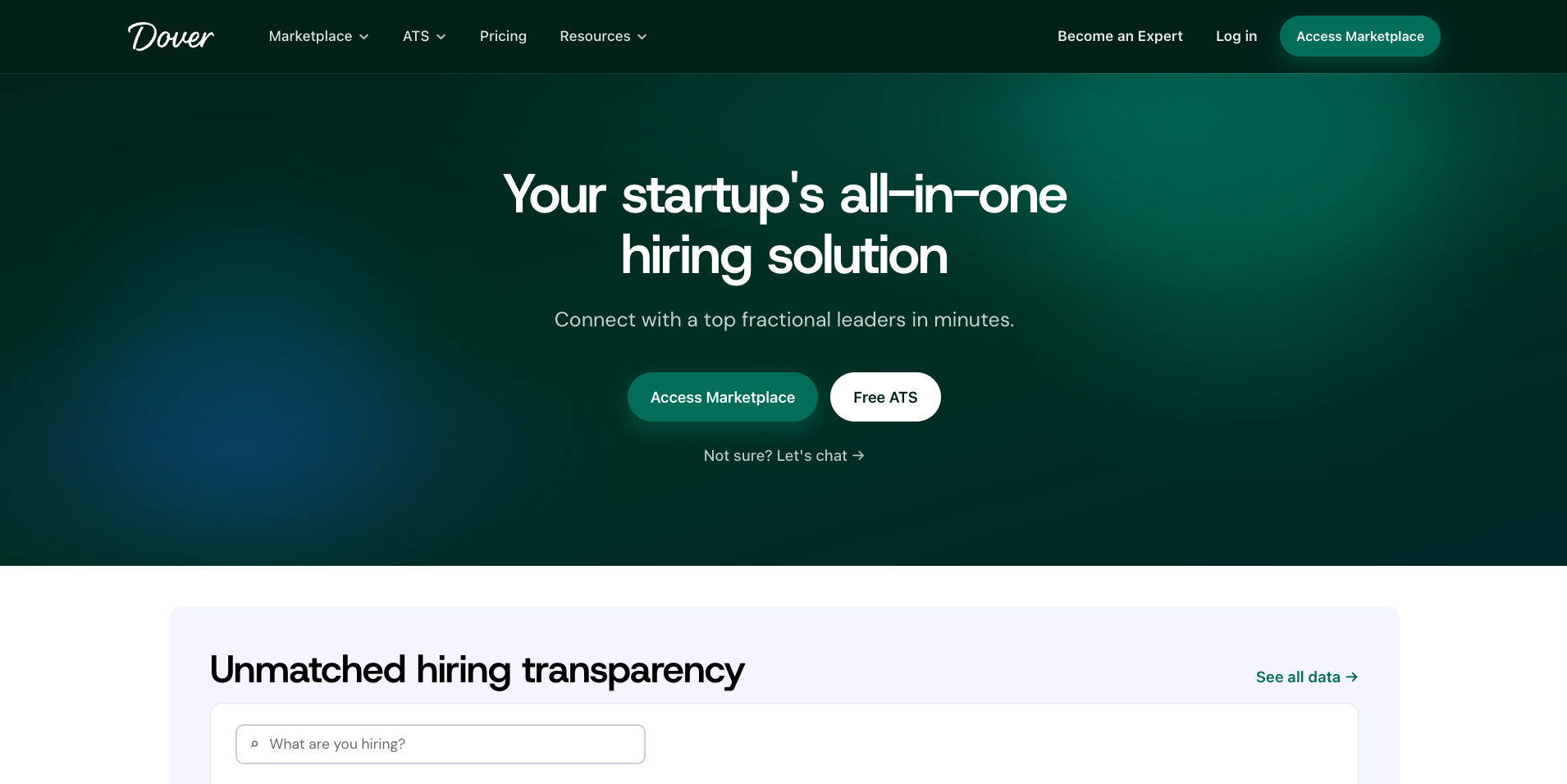
Dover supplies fractional recruiters on an hourly basis at around $80 per hour, giving a team recruiting capacity without a full-time hire.
Hourly recruiting capacity is the cheapest way onto this list, and for a team with its own technical bar it can be enough.
Generalist recruiters are the documented limit. Independent comparisons describe fractional generalists as unable to source passive senior ML talent, which is precisely the candidate that makes an AI search hard.
Our verdict: the price is the argument, and it holds for volume roles with a clear spec. Frontier or senior AI hiring asks for judgement the hourly model is not structured to supply.
#5 Toptal
Toptal is a freelance network accepting fewer than 3% of applicants, with AI and ML engineers among its highest-billing categories.
Human-led vetting is real and the 24-hour shortlist is fast. Hiring AI engineers pushes rates past the $200 mark, the top of the platform's range.
An ongoing margin sits inside every hour. Independent analyses put it at 30% to 60% above the engineer's take-home, alongside a $500 deposit and a $79 monthly fee, with no path onto your payroll.
Our verdict: for a defined AI build under three months the rigour justifies the premium. Past that the arithmetic turns, because the platform has no exit from the hourly model.
#6 Wellfound
Wellfound combines AI sourcing, applicant review, and a free ATS in one platform aimed at startups, with an optional managed recruiting tier.
A startup-weighted pool is the advantage, drawing engineers, ML practitioners, and data scientists who are already looking at early-stage companies.
Software, not a partner is what you are buying at the entry tier. Plans start at $115 and the managed sourcing tier is quoted on request, so the evaluation work stays in-house unless that tier is added.
Our verdict: for a team with its own technical bar this is efficient and inexpensive. The screening depth an AI hire needs is the part it leaves to you.
#7 Insight Global
Insight Global is a talent and consulting company ranked the 4th largest staffing firm in the US, often used as a recruiting agency for infrastructure roles alongside AI-adjacent data and cloud hiring.
Speed from scale is genuine: candidates are typically screened within 24 to 48 hours, among the fastest in traditional staffing.
A high-volume desk model produces that speed. Recruiters hold a 3.0 out of 5 Glassdoor rating across 1,358 reviews against a 3.7 sector average, and reviews describe checklist screening rather than a working grasp of the role.
Our verdict: for AI-adjacent roles with a clear spec the turnaround is hard to beat. The deeper the ML requirement, the more of the evaluation comes back to you.
#8 Scion Technical
Scion Technical is a US technical recruiting firm with access to a 14M+ talent network, running a dedicated practice for organisations building AI and ML capability.
A dedicated AI and ML practice separates this from a generalist desk, with recruiters working technology roles exclusively across a 14M+ network.
US-only coverage is the constraint, alongside pricing and replacement terms that are not published, so both are settled in negotiation.
Our verdict: the specialisation is real for US hiring. Reach and published terms are the two things to establish before the search starts.
#9 Valintry
Valintry is a technology staffing firm that extended into AI staffing, offering contract, contract-to-hire, and direct-hire models across AI engineer, ML specialist, data scientist, and NLP roles.
Three engagement models on one search is the flexibility here, letting a role start as contract and convert without changing vendor.
An extension of tech staffing is what the AI practice is, added to an existing technology desk, so depth on frontier ML work is worth probing directly.
Our verdict: the model flexibility is a real advantage over single-mode firms. How deep the AI bench actually runs is the question to put to them first.
#10 GoGloby
GoGloby markets itself as an applied AI engineering partner, placing embedded engineers and building AI workflows through nearshore hiring.
Embedded applied-AI teams is the shape of the offer, closer to delivery capacity than to recruiting, which suits a workflow that needs building more than a seat that needs filling.
Terms not published across pricing, replacement, and employment structure, so the commercial and compliance questions are settled entirely in conversation.
Our verdict: the applied-AI framing is a genuine differentiator against resume-forwarding firms. The absence of published terms means more diligence before signing, not less.
#11 True Search
True Search recruits AI, data, and technology leaders for venture-backed, growth-stage, and enterprise organisations, focused on executive and senior leadership mandates.
Retained search for AI leadership is the right model when the hire is a single executive who will set technical direction, with deep assessment and access to candidates who are not looking.
Executive scope only means the retained fee structure applies regardless, which makes it an expensive way to fill engineering seats.
Our verdict: for an AI leadership mandate this is the correct instrument. Using it for a bulk ML engineering hire misaligns the model with the need.
Where We Land
The firms here split by instrument. True Search runs retained search for leadership, Paraform puts specialist recruiters on a single permanent hire, Dover sells recruiting hours, and Turing and Toptal bill by the hour from a global pool. Each is built for one shape of need.
AI hiring rarely arrives as one shape. A brief that starts as one ML engineer turns into a data pipeline, then a question about who owns the architecture, then an argument about whether to build or buy. Instruments that fit one of those do not stretch to the others.
Tecla was built across that whole span, screening every candidate for AI fluency, employing them under EOR, and scoping the system itself when the honest answer to a brief is a build, not a seat.
Frequently Asked Questions





%20(1).avif)