
IT staffing agencies range from large national firms billing an hourly markup to boutique specialists built around one vetting process. The real differences show up in how each firm screens candidates, prices the engagement, and stays accountable once someone starts the job.
This list ranks 9 IT staffing agencies against the same core dimensions: vetting methodology, pricing and markup, geographic reach, specialization depth, and what happens when a placement doesn't work out.
Each dimension was scored against real hiring experiences with these agencies and customer reviews found online.
Top 9 IT Staffing Agencies
#1 Tecla
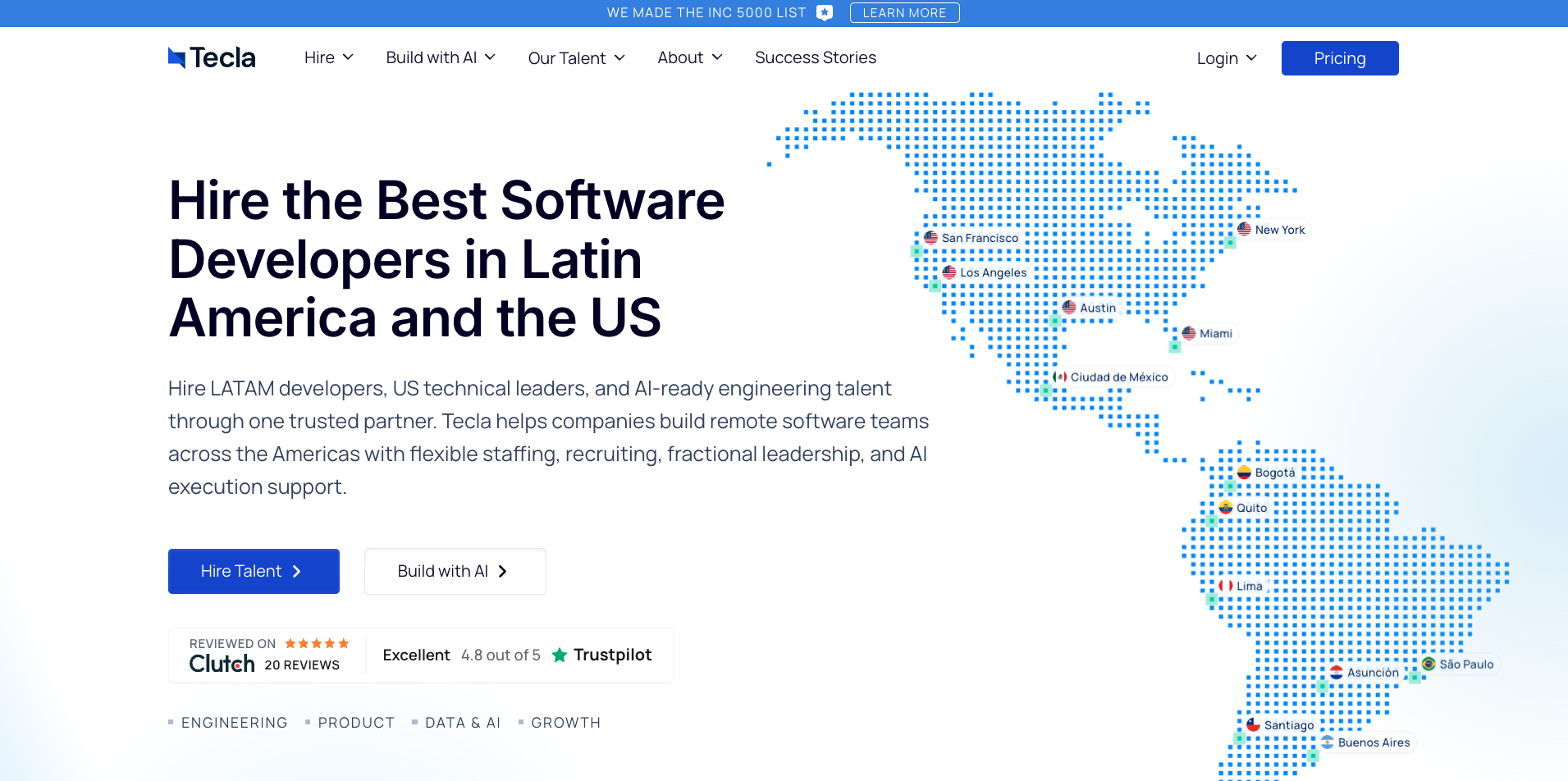
Tecla is a flexible AI-first technical talent partner across the US and Latin America, founded in 2013 to help US companies hire engineers and AI talent through one vetted network. The network spans 50,000+ professionals across the US and 18+ countries in Latin America, supporting 500+ companies through staffing, direct-hire, staff augmentation, and fractional leadership, with compliance handled by default.
Live technical vetting runs before any candidate reaches a client, combining a technical assessment with an AI-readiness screen. Both apply to every candidate at every tier.
Flexible engagement formats mean the relationship can start as staffing and move into direct-hire, staff augmentation, or fractional leadership as the need changes, priced as one scoped engagement rather than a published bill-rate markup.
Fast first interviews keep the front of the process short: candidates reach an interview within 5 days of the intake call.
A 90-day replacement guarantee sits in the engagement agreement, confirmed before signing. It is rarely called on: 97% of placements succeed and 96% of the talent stays.
Our verdict: for a company planning past the first hire, Tecla covers more of the relationship in one place than the larger staffing brands on this list, which rely on published markups and narrower engagement types.
#2 Robert Half Technology
Robert Half Technology is the IT staffing division of Robert Half Inc., founded in 1948 and publicly traded on the NYSE, with more than 400 locations worldwide and roughly $5.8 billion in annual revenue.
Steep contract markups define the pricing here: 70% to 75% over pay rate, with placement fees around 30% to 35% of first-year salary for direct hires, according to independent pricing reviews.
Finance and accounting is where the firm's deepest bench and strongest reputation sit. Technology operates as one division inside that larger practice, which shapes how much specialist depth a senior engineering req actually reaches.
A 90-day guarantee period appears in Robert Half's SEC filings as a revenue-recognition assumption on direct-hire placements, and independent reviews describe re-sourcing inside that window without a second placement fee. Worth asking for in writing, since it surfaces in financial disclosures rather than in any client-facing commitment.
Our verdict: brand recognition and process maturity are real assets, and on direct-hire work the accountability is there once you get it into the contract. The markup runs high, and senior or highly specialized technical roles often fit better with a firm built around technology alone.
#3 Insight Global
Insight Global is a talent and consulting company founded in 2001 in Atlanta, ranked the 4th largest staffing firm in the US by Staffing Industry Analysts, with more than 40,000 employees and contractors across 40 countries.
Fast candidate screening is the standout here: candidates can typically be identified and screened within 24 to 48 hours, among the fastest turnarounds in traditional staffing.
A high-volume desk model is what produces that speed. Recruiters at Insight Global hold a 3.0 out of 5 Glassdoor rating across 1,358 reviews, below the 3.7 average for the sector, and recurring reviews describe screening that runs off a checklist rather than a working grasp of the role. The 24-hour shortlist arrives; the judgment behind it is the variable.
Our verdict: for a well-defined req where the hiring manager does the technical filtering anyway, the turnaround is hard to beat. For a senior or ambiguous role, the screening layer is thin enough that the work lands back on your side, and the cost only comes into focus once it has been negotiated.
#4 TEKsystems
TEKsystems is a technology staffing and services company founded in 1983, part of Allegis Group, with roughly $7 billion in annual revenue and more than 10,000 employees, historically ranked the #1 national IT staffing firm.
Deep IT specialization sets the firm apart: TEKsystems focuses specifically on technology staffing, applications, infrastructure, and communications, more focused than generalist staffing firms on this list.
High internal turnover shows up clearly in TEKsystems' own Glassdoor reviews, where employees and account managers describe frequent churn on the team, which creates a real continuity risk for whoever depends on a stable point of contact on the other side of that relationship.
Our verdict: the IT-only focus and scale are real advantages, but continuity is the risk worth watching, since a relationship built on account management doesn't hold up well when internal turnover changes that contact every few months.
#5 Actalent
Actalent is an engineering and sciences staffing company under the Allegis Group umbrella, rebranded from EASi, with roughly $1.1 billion in revenue, 5,000 to 10,000 employees, and 125 locations across the US.
Broad engineering focus defines Actalent's core strength: product, manufacturing, environmental, and healthcare roles sit alongside IT as one practice among several rather than the sole focus.
Strong client satisfaction backs that range up: Actalent has earned ClearlyRated's Best of Staffing award, with scores in the 4.4 to 4.8 range across multiple city offices, ahead of its 3.5 Glassdoor employee rating.
Our verdict: the client-side satisfaction scores are real and worth weighing. The harder question is which kind of engineering. TEKsystems, Actalent's sibling under Allegis, is the one built for technology staffing, while Actalent's desks are organized around lab, clinical, and manufacturing work. A backend or infrastructure req gets screened against reference points from a different discipline.
#6 Motion Recruitment
Motion Recruitment is a technology recruiting and staffing firm founded in 1989, ranked among the top 15 US IT staffing firms, acquired by Kelly Services in 2024 for an estimated $425 to $485 million.
Narrow tech specialization runs deep here: software, mobile, data, infrastructure, and cybersecurity roles, narrower and more focused than the generalist staffing brands on this list.
A major ownership change followed in 2024, when Kelly Services acquired the previously independent firm. Two questions are worth settling before signing: which team actually fills the req, Motion's specialist desks or Kelly's broader delivery network, and whether the rate structure quoted now survives the first renewal under the parent's contract terms.
Our verdict: the specialized tech focus is a real differentiator against the generalist staffing firms on this list. The acquisition puts a question mark on who delivers against that focus, and it is the kind of question the contract can answer before any money moves.
#7 Randstad Technologies
Randstad Technologies is the IT staffing division of Randstad, the world's largest HR services company, founded in the Netherlands in 1960, publicly traded, and operating in 38+ countries with roughly $5 billion in US technology division revenue.
A steep bill rate defines the pricing: independent reviews place it at 1.5 to 2 times the candidate's pay rate, roughly 50% to 100% markup, with direct-hire placement fees in the 15% to 25% range.
Divisional handoffs are the recurring complaint, and they follow directly from the size. Randstad runs separate desks by discipline, and reviews across Yelp (2.0 from 220 reviews) and PissedConsumer (1.8 from 172) describe contractors bounced between divisions, entered into the wrong system, and paid at the wrong rate while it gets sorted. Those are candidate-side accounts, and they reach the client as onboarding friction and as contractors distracted by their own payroll.
Our verdict: the footprint is unmatched and genuinely useful for multi-country programs. The cost shows up in coordination: with this many desks, someone on your side ends up owning the handoffs, and that time is not in the bill rate.
#8 Toptal
Toptal is a global freelance network founded in 2010, with fewer than 3% of applicants passing a human-led vetting process that includes a live technical interview and a multi-week test project.
A two-week trial backs every match, with 24-hour candidate presentation as a genuine strength, though no guarantee applies once that window closes.
A margin that never ends is the structural cost. Rates run $60 to $200+ per hour with the markup embedded and unbroken out, estimated by third-party analyses at 30% to 60% over the engineer's take-home, plus a $500 deposit and a $79 monthly platform fee that runs until cancelled. On a two-year engagement you are paying that margin in month 24 exactly as in month 1.
Non-exclusive by design is the other thing to know: talent works as independent contractors and can hold other clients at the same time, so "full-time" describes the hours reserved, not a dedicated engineer. Compliance sits with the client unless EOR is bought as a separate product.
Our verdict: for a defined project under three months, the vetting and the 24-hour shortlist are worth the premium. Past that, the marketplace has no exit from the hourly model, so a role that turns permanent keeps paying platform margin with no path to converting the engineer onto your own payroll.
#9 Turing
Turing is an AI-powered developer marketplace founded in 2018, with a pool of 3M+ developers across 150+ countries matched through an automated vetting funnel.
Fast AI-matched sourcing is the draw: candidates surface in 3 to 5 days, though developers work as independent contractors with classification sitting entirely with the client.
Undisclosed rates with a large embedded margin define the cost. Turing publishes no rate card; third-party benchmarks place billing at $100 to $200 per hour for mid-to-senior engineers, and multiple independent reviews estimate that 50% to 55% of each invoice is retained as service margin. Turing has not confirmed the figure, and the invoice carries no breakdown, so the client cannot verify it either way.
Two structural limits show up consistently in 2026 reviews. Developers are independent contractors who may hold other clients, and exclusive assignment is not a standard feature, so a 40-hour engagement is not the same as a dedicated engineer. Timezone commitment is a four-hour minimum overlap rather than full US business hours.
Our verdict: the matching speed and the size of the pool are real. The question is what a five-figure monthly bill is buying when the margin is unverifiable, the engineer may be shared, and the classification risk stays with you.
What We Think
Every firm on this list trades one strength for a gap elsewhere. Robert Half's brand recognition comes with a steep markup, TEKsystems' IT depth comes with high account turnover, and Randstad's reach comes with a generalist model that treats technology as one vertical among many.
Each of those firms was built to solve a narrower problem well, and on that problem they deliver. Growing a long-term technical team is a wider one. It needs room to shift engagement models mid-relationship, and vetting that reads how a candidate approaches automation and architecture decisions with AI in hand.
That wider problem is the one Tecla was built for, with one team carrying the hire, the compliance, and whatever the role grows into next.
Frequently Asked Questions





%20(1).avif)